Ch. 10 - Sequences and Infinite Series
Briggs - Calculus: Early Transcendentals 3rd Edition
Briggs3rd EditionCalculus: Early TranscendentalsISBN: 9780136847243Not the one you use?Change textbook
Chapter 10, Problem 10.3.61

54–69. Telescoping series
For the following telescoping series, find a formula for the nth term of the sequence of partial sums {Sₙ}. Then evaluate limₙ→∞ Sₙ to obtain the value of the series or state that the series diverges.


61. ∑ (k = 1 to ∞) ln((k + 1) / k)

Verified step by step guidance
1
Recognize that the given series is a telescoping series of the form \( \sum_{k=1}^\infty \ln\left(\frac{k+1}{k}\right) \). The key is to express the general term in a way that reveals cancellation when summed.
Rewrite the general term using logarithm properties: \( \ln\left(\frac{k+1}{k}\right) = \ln(k+1) - \ln(k) \). This difference form is what allows telescoping.
Write the nth partial sum \( S_n \) as the sum of the first n terms: \[ S_n = \sum_{k=1}^n \left( \ln(k+1) - \ln(k) \right) \].
Expand the sum to observe cancellation: \[ S_n = (\ln 2 - \ln 1) + (\ln 3 - \ln 2) + \cdots + (\ln(n+1) - \ln n) \]. Notice that most terms cancel out, leaving only \( \ln(n+1) - \ln 1 \).
Express the simplified partial sum as \( S_n = \ln(n+1) - \ln(1) \). Since \( \ln(1) = 0 \), this reduces to \( S_n = \ln(n+1) \). To find the sum of the infinite series, evaluate \( \lim_{n \to \infty} S_n = \lim_{n \to \infty} \ln(n+1) \). Determine whether this limit converges or diverges.

Verified video answer for a similar problem:

This video solution was recommended by our tutors as helpful for the problem above.
Video duration:
3m
Was this helpful?

Key Concepts

Here are the essential concepts you must grasp in order to answer the question correctly.

Telescoping Series

A telescoping series is a series whose partial sums simplify because many terms cancel out. Typically, each term can be written as the difference of two successive terms in a sequence, allowing the sum to reduce to just a few terms. This simplification makes it easier to find the nth partial sum and analyze convergence.
Recommended video:
06:00
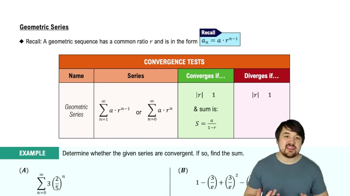
Geometric Series

Partial Sums and Their Limits

The partial sum Sₙ of a series is the sum of its first n terms. To determine the series' behavior, we find a formula for Sₙ and then evaluate the limit as n approaches infinity. If this limit exists and is finite, the series converges to that value; otherwise, it diverges.
Recommended video:
08:01
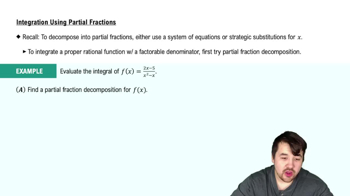
Integration Using Partial Fractions

Properties of Logarithms

Logarithmic properties, such as ln(a/b) = ln(a) - ln(b), help simplify terms in the series. Applying these properties can transform the series into a telescoping form by expressing each term as a difference of logarithms, which is essential for finding the partial sums and evaluating the limit.
Recommended video:
05:36
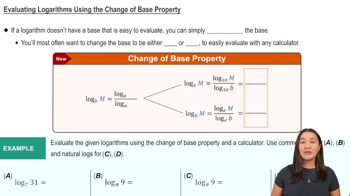
Change of Base Property