Ch. 10 - Sequences and Infinite Series
Briggs - Calculus: Early Transcendentals 3rd Edition
Briggs3rd EditionCalculus: Early TranscendentalsISBN: 9780136847243Not the one you use?Change textbook
Chapter 10, Problem 10.3.63

54–69. Telescoping series
For the following telescoping series, find a formula for the nth term of the sequence of partial sums {Sₙ}. Then evaluate limₙ→∞ Sₙ to obtain the value of the series or state that the series diverges.


63. ∑ (k = 1 to ∞) 1 / ((k + p)(k + p + 1)), where p is a positive integer

Verified step by step guidance
1
Start by expressing the general term of the series: \( a_k = \frac{1}{(k+p)(k+p+1)} \). Our goal is to rewrite this term in a form that reveals telescoping behavior.
Use partial fraction decomposition to break \( a_k \) into simpler fractions. Set \( \frac{1}{(k+p)(k+p+1)} = \frac{A}{k+p} + \frac{B}{k+p+1} \) and solve for constants \( A \) and \( B \).
After finding \( A \) and \( B \), rewrite \( a_k \) as \( \frac{1}{k+p} - \frac{1}{k+p+1} \). This form shows the telescoping nature because consecutive terms will cancel out when summed.
Write the nth partial sum \( S_n = \sum_{k=1}^n a_k = \sum_{k=1}^n \left( \frac{1}{k+p} - \frac{1}{k+p+1} \right) \). Expand this sum to see the cancellation of intermediate terms.
Identify the terms that remain after cancellation to write a formula for \( S_n \). Then, evaluate \( \lim_{n \to \infty} S_n \) by considering the behavior of the remaining terms as \( n \) approaches infinity to determine if the series converges or diverges.

Verified video answer for a similar problem:

This video solution was recommended by our tutors as helpful for the problem above.
Video duration:
6m
Was this helpful?

Key Concepts

Here are the essential concepts you must grasp in order to answer the question correctly.

Telescoping Series

A telescoping series is a series whose partial sums simplify by canceling intermediate terms, leaving only a few terms from the beginning and end. This simplification makes it easier to find a closed-form expression for the nth partial sum and analyze convergence.
Recommended video:
06:00
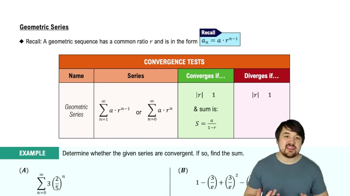
Geometric Series

Partial Sums and Their Limits

The partial sum Sₙ of a series is the sum of its first n terms. Evaluating the limit of Sₙ as n approaches infinity helps determine whether the series converges to a finite value or diverges. For telescoping series, this limit often involves evaluating the remaining terms after cancellation.
Recommended video:
08:01
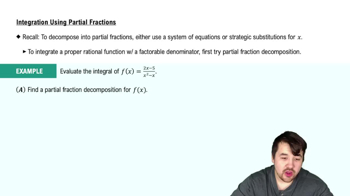
Integration Using Partial Fractions

Partial Fraction Decomposition

Partial fraction decomposition breaks a complex rational expression into simpler fractions that are easier to sum or integrate. In telescoping series, it helps rewrite terms so that consecutive terms cancel out, facilitating the identification of the telescoping pattern.
Recommended video:
10:07
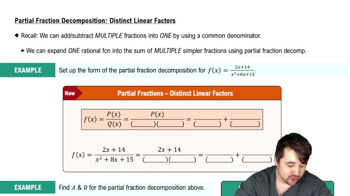
Partial Fraction Decomposition: Distinct Linear Factors