
Ch. 10 - Sequences and Infinite Series
Briggs - Calculus: Early Transcendentals 3rd Edition
Briggs3rd EditionCalculus: Early TranscendentalsISBN: 9780136847243Not the one you use?Change textbook
Chapter 10, Problem 10.4.57

48–63. Choose your test Determine whether the following series converge or diverge using the properties and tests introduced in Sections 10.3 and 10.4.
∑ (k = 1 to ∞) (5 / 6)⁻ᵏ

Verified step by step guidance
1
Identify the type of series given. The series is \( \sum_{k=1}^{\infty} \left( \frac{5}{6} \right)^{-k} \), which can be rewritten using properties of exponents.
Rewrite the term \( \left( \frac{5}{6} \right)^{-k} \) as \( \left( \frac{6}{5} \right)^k \) because \( a^{-k} = \frac{1}{a^k} \) and here the negative exponent flips the fraction.
Recognize that the series is now a geometric series of the form \( \sum_{k=1}^{\infty} r^k \) where \( r = \frac{6}{5} \).
Recall the convergence criterion for a geometric series: it converges if and only if \( |r| < 1 \). If \( |r| \geq 1 \), the series diverges.
Since \( r = \frac{6}{5} \) and \( \left| \frac{6}{5} \right| > 1 \), conclude that the series diverges by the geometric series test.

Verified video answer for a similar problem:

This video solution was recommended by our tutors as helpful for the problem above.
Video duration:
2m
Was this helpful?

Key Concepts

Here are the essential concepts you must grasp in order to answer the question correctly.

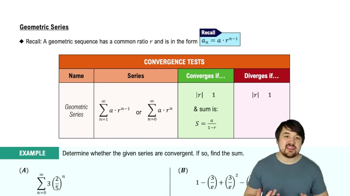
Geometric Series

A geometric series is a series where each term is obtained by multiplying the previous term by a constant ratio r. It converges if the absolute value of r is less than 1, and its sum can be found using the formula S = a / (1 - r), where a is the first term.
Recommended video:
06:00
Geometric Series

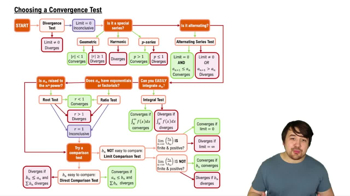
Convergence Tests for Series

Convergence tests help determine whether an infinite series converges or diverges. For geometric series, the key test is checking if the common ratio's absolute value is less than 1. Other tests include the nth-term test, comparison test, and ratio test, but geometric series have a straightforward criterion.
Recommended video:
07:51
Choosing a Convergence Test

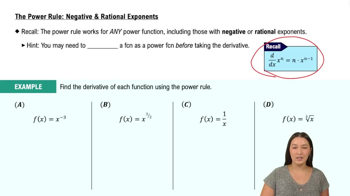
Properties of Exponents and Negative Powers

Understanding how to manipulate expressions with negative exponents is essential. A term like (5/6)^(-k) equals (6/5)^k, which changes the behavior of the series. Recognizing this helps correctly identify the common ratio and apply the appropriate convergence test.
Recommended video:
04:09
The Power Rule: Negative & Rational Exponents