
Textbook Question
Suppose the sequence { aₙ} is defined by the explicit formula aₙ = 1/n, for n=1, 2, 3, .....Write out the first five terms of the sequence.

 Verified step by step guidance
 07:51
07:51 07:51
07:51 07:45
07:45Suppose the sequence { aₙ} is defined by the explicit formula aₙ = 1/n, for n=1, 2, 3, .....Write out the first five terms of the sequence.
46–53. Decimal expansions
Write each repeating decimal first as a geometric series and then as a fraction (a ratio of two integers).
49.0.037̅ = 0.037037…
54–69. Telescoping series
For the following telescoping series, find a formula for the nth term of the sequence of partial sums {Sₙ}. Then evaluate limₙ→∞ Sₙ to obtain the value of the series or state that the series diverges.
57. ∑ (k = 1 to ∞) 1 / ((k + 6)(k + 7))
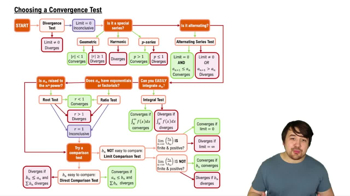
48–63. Choose your test Determine whether the following series converge or diverge using the properties and tests introduced in Sections 10.3 and 10.4.
∑ (k = 1 to ∞) k / √(k² + 1)
13–52. Limits of sequences
Find the limit of the following sequences or determine that the sequence diverges.
{(3n³ − 1)⁄(2n³ + 1)}
11–86. Applying convergence tests Determine whether the following series converge. Justify your answers.
∑ (from k = 1 to ∞) (−1)ᵏ × k / (k³ + 1)