Ch. 10 - Sequences and Infinite Series
Briggs - Calculus: Early Transcendentals 3rd Edition
Briggs3rd EditionCalculus: Early TranscendentalsISBN: 9780136847243Not the one you use?Change textbook
Chapter 10, Problem 10.6.43

39–44. {Use of Tech} Estimating infinite series Estimate the value of the following convergent series with an absolute error less than 10⁻³.


∑ (k = 1 to ∞) (−1)ᵏ / kᵏ

Verified step by step guidance
1
Recognize that the series given is an alternating series of the form \(\sum_{k=1}^{\infty} \frac{(-1)^k}{k^k}\), where the terms alternate in sign and decrease in absolute value as \(k\) increases.
Recall the Alternating Series Estimation Theorem, which states that the absolute error when approximating an alternating series by its first \(n\) terms is less than or equal to the absolute value of the first omitted term, i.e., \(|R_n| \leq |a_{n+1}|\).
To estimate the sum with an absolute error less than \(10^{-3}\), find the smallest integer \(n\) such that the absolute value of the \((n+1)\)-th term satisfies \(\left| \frac{(-1)^{n+1}}{(n+1)^{n+1}} \right| < 10^{-3}\).
Calculate the partial sum \(S_n = \sum_{k=1}^n \frac{(-1)^k}{k^k}\) by adding the first \(n\) terms of the series.
Use the partial sum \(S_n\) as the estimate of the infinite series sum, knowing that the error is less than \(10^{-3}\) due to the Alternating Series Estimation Theorem.

Verified video answer for a similar problem:

This video solution was recommended by our tutors as helpful for the problem above.
Video duration:
3m
Was this helpful?

Key Concepts

Here are the essential concepts you must grasp in order to answer the question correctly.

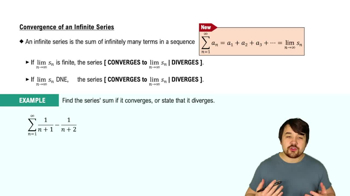
Convergence of Infinite Series

An infinite series converges if the sum of its terms approaches a finite limit as the number of terms increases indefinitely. For alternating series like this one, convergence can often be tested using the Alternating Series Test, which requires terms to decrease in absolute value and approach zero.
Recommended video:
06:52
Convergence of an Infinite Series

Alternating Series Estimation Theorem

This theorem states that for an alternating series with decreasing terms, the absolute error when approximating the sum by the first n terms is less than or equal to the absolute value of the (n+1)th term. This helps in determining how many terms are needed to achieve a desired error bound.
Recommended video:
06:00
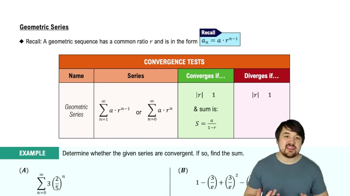
Geometric Series

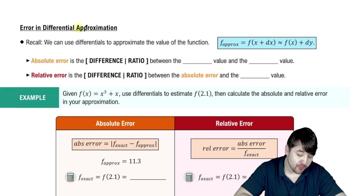
Absolute Error and Approximation

Absolute error measures the difference between the true value of a series and its approximation. To estimate a series within a specified absolute error (e.g., less than 10⁻³), one must sum enough terms so that the remainder (error) is smaller than this threshold, ensuring the approximation is sufficiently accurate.
Recommended video:
04:57
Determining Error and Relative Error