
Ch. 10 - Sequences and Infinite Series
Briggs - Calculus: Early Transcendentals 3rd Edition
Briggs3rd EditionCalculus: Early TranscendentalsISBN: 9780136847243Not the one you use?Change textbook
Chapter 10, Problem 10.4.39c

39–40. {Use of Tech} Lower and upper bounds of a series
For each convergent series and given value of n, use Theorem 10.13 to complete the following.


c. Find lower and upper bounds (Lₙ and Uₙ, respectively) for the exact value of the series.


39. ∑ (k = 1 to ∞) 1 / k⁷ ; n = 2

Verified step by step guidance
1
Identify the series given: \( \sum_{k=1}^{\infty} \frac{1}{k^7} \). This is a p-series with \( p = 7 > 1 \), so it converges.
Recall Theorem 10.13, which states that for a convergent series with positive, decreasing terms, the remainder \( R_n = S - S_n \) (the error when approximating the sum by the first \( n \) terms) is bounded by the integral test inequalities:
\[ \int_{n+1}^{\infty} f(x) \, dx \leq R_n \leq \int_n^{\infty} f(x) \, dx, \]
where \( f(x) = \frac{1}{x^7} \) in this problem. Here, \( S_n = \sum_{k=1}^n \frac{1}{k^7} \) is the partial sum up to \( n = 2 \).
Calculate the integrals to find the bounds for the remainder:
\[ \int_n^{\infty} \frac{1}{x^7} \, dx \quad \text{and} \quad \int_{n+1}^{\infty} \frac{1}{x^7} \, dx. \]
Finally, use these bounds to write the inequalities for the exact sum \( S \):
\[ S_n + \int_{n+1}^{\infty} \frac{1}{x^7} \, dx \leq S \leq S_n + \int_n^{\infty} \frac{1}{x^7} \, dx. \]

Verified video answer for a similar problem:

This video solution was recommended by our tutors as helpful for the problem above.
Video duration:
5m
Was this helpful?

Key Concepts

Here are the essential concepts you must grasp in order to answer the question correctly.

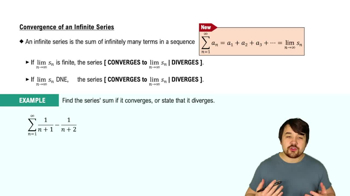
Convergent Series

A convergent series is an infinite sum whose partial sums approach a finite limit. Understanding convergence ensures that the series has a well-defined sum, which is essential when estimating bounds for the series' exact value.
Recommended video:
06:52
Convergence of an Infinite Series

Theorem 10.13 (Bounds for Series Sums)

Theorem 10.13 provides a method to find lower and upper bounds for the sum of a convergent series using partial sums and remainder estimates. It typically involves comparing the remainder to an integral or another expression to bound the error after n terms.
Recommended video:
06:45
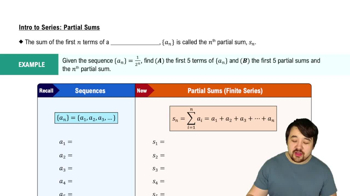
Intro to Series: Partial Sums

Partial Sums and Remainder Estimation

Partial sums sum the first n terms of a series, approximating the total sum. The remainder is the difference between the exact sum and the partial sum. Estimating this remainder allows us to find bounds (Lₙ and Uₙ) that enclose the true sum.
Recommended video:
05:59
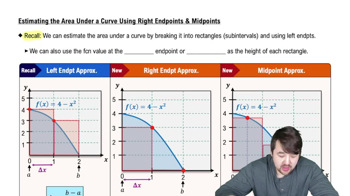
Estimating the Area Under a Curve with Right Endpoints & Midpoint
Related Practice
Textbook Question

Explain why or why not

Determine whether the following statements are true and give an explanation or counterexample.


c.The convergent sequences {aₙ} and {bₙ} differ in their first 100 terms, but aₙ = bₙ for n > 100.

It follows that limₙ→∞aₙ = limₙ→∞bₙ.

Textbook Question

Explain why or why not

Determine whether the following statements are true and give an explanation or counterexample.


b.If limₙ→∞aₙ = 0 and limₙ→∞bₙ = ∞, then limₙ→∞aₙbₙ = 0.

1
views
Textbook Question

{Use of Tech} Periodic dosing

Many people take aspirin on a regular basis as a preventive measure for heart disease. Suppose a person takes 80 mg of aspirin every 24 hours. Assume aspirin has a half-life of 24 hours; that is, every 24 hours, half of the drug in the blood is eliminated.


c.Assuming the sequence has a limit, confirm the result of part (b) by finding the limit of {dₙ} directly.

1
views
Textbook Question

Loglog p-series Consider the series ∑ (k = 2 to ∞) 1 / (k(ln k)(ln ln k)ᵖ), where p is a real number.

b. Which of the following series converges faster? Explain.

∑ (k = 2 to ∞) 1 / (k(ln k)²) or ∑ (k = 3 to ∞) 1 / (k(ln k)(ln ln k)²)?

Textbook Question

Explain why or why not Determine whether the following statements are true and give an explanation or counterexample.


c. Suppose f is a continuous, positive, decreasing function, for x ≥ 1, and aₖ = f(k), for k = 1, 2, 3, …. If ∑ (k = 1 to ∞) aₖ converges to L, then ∫ (1 to ∞) f(x) dx converges to L.

Textbook Question

41–44. {Use of Tech} Remainders and estimates Consider the following convergent series.


c. Find lower and upper bounds (Lₙ and Uₙ, respectively) on the exact value of the series.


41. ∑ (k = 1 to ∞) 1 / k⁶