Ch. 10 - Sequences and Infinite Series
Briggs - Calculus: Early Transcendentals 3rd Edition
Briggs3rd EditionCalculus: Early TranscendentalsISBN: 9780136847243Not the one you use?Change textbook
Chapter 10, Problem 10.6.33

33–38. {Use of Tech} Remainders in alternating series Determine how many terms of the following convergent series must be summed to be sure that the remainder is less than 10⁻⁴ in magnitude. Although you do not need it, the exact value of the series is given in each case.


ln 2 = ∑ (k = 1 to ∞) (−1)ᵏ⁺¹ / k

Verified step by step guidance
1
Recognize that the given series is an alternating series of the form \(\sum_{k=1}^\infty (-1)^{k+1} \frac{1}{k}\), which converges to \(\ln 2\).
Recall the Alternating Series Estimation Theorem, which states that the magnitude of the remainder \(R_n\) after summing \(n\) terms is less than or equal to the absolute value of the first omitted term: \(|R_n| \leq \left| a_{n+1} \right|\).
Identify the general term \(a_k = \frac{1}{k}\), so the remainder after \(n\) terms satisfies \(|R_n| \leq \frac{1}{n+1}\).
Set up the inequality to ensure the remainder is less than \(10^{-4}\): \(\frac{1}{n+1} < 10^{-4}\).
Solve this inequality for \(n\) to find the minimum number of terms needed: multiply both sides by \(n+1\) and then divide by \(10^{-4}\), leading to \(n + 1 > 10^{4}\), so \(n\) must be at least \(9999\).

Verified video answer for a similar problem:

This video solution was recommended by our tutors as helpful for the problem above.
Video duration:
1m
Was this helpful?

Key Concepts

Here are the essential concepts you must grasp in order to answer the question correctly.

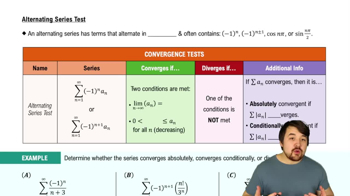
Alternating Series Test

The Alternating Series Test determines if a series with terms alternating in sign converges. It requires that the absolute value of terms decreases monotonically to zero. If these conditions hold, the series converges, which is essential for applying remainder estimates.
Recommended video:
10:54
Alternating Series Test

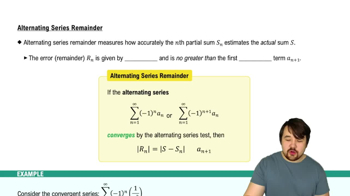
Remainder (Error) Estimation in Alternating Series

For an alternating series that meets the test conditions, the remainder after summing n terms is less than or equal to the absolute value of the (n+1)th term. This allows us to bound the error and decide how many terms to sum to achieve a desired accuracy.
Recommended video:
06:32
Alternating Series Remainder

Logarithmic Series Representation

The natural logarithm of 2 can be expressed as an alternating series: ln(2) = ∑ (−1)^{k+1} / k. Understanding this series form helps apply the alternating series remainder estimate to find how many terms are needed for a given precision.
Recommended video:
06:00
Geometric Series