
Textbook Question
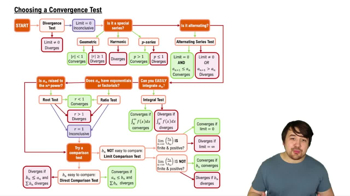
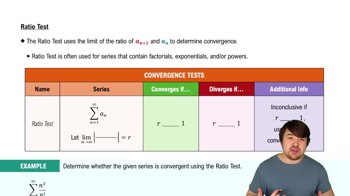
9–30. The Ratio and Root Tests Use the Ratio Test or the Root Test to determine whether the following series converge absolutely or diverge.
∑ (from k = 1 to ∞) (k² / 4ᵏ)

 Verified step by step guidance
 07:51
07:51
 05:35
05:35 5:22
5:229–30. The Ratio and Root Tests Use the Ratio Test or the Root Test to determine whether the following series converge absolutely or diverge.
∑ (from k = 1 to ∞) (k² / 4ᵏ)
23–38. Divergence, Integral, and p-series Tests Use the Divergence Test, the Integral Test, or the p-series test to determine whether the following series converge.
∑ (k = 1 to ∞) k^(–1/5)
9–15. Geometric sums Evaluate each geometric sum.
{Use of Tech}∑ k = 0 to 20(2/5)²ᵏ
Why does the value of a converging alternating series with terms that are nonincreasing in magnitude lie between any two consecutive terms of its sequence of partial sums?
39–44. {Use of Tech} Estimating infinite series Estimate the value of the following convergent series with an absolute error less than 10⁻³.
∑ (k = 1 to ∞) (−1)ᵏ / k⁵
17–22. Integral Test Use the Integral Test to determine whether the following series converge after showing that the conditions of the Integral Test are satisfied.
∑ (k = 1 to ∞) 1 / (∛(5k + 3))