Ch. 10 - Sequences and Infinite Series
Briggs - Calculus: Early Transcendentals 3rd Edition
Briggs3rd EditionCalculus: Early TranscendentalsISBN: 9780136847243Not the one you use?Change textbook
Chapter 10, Problem 10.2.47

13–52. Limits of sequences
Find the limit of the following sequences or determine that the sequence diverges.


{(1 / n)¹⁄ⁿ}

Verified step by step guidance
1
Identify the given sequence: \(a_n = \left( \frac{1}{n} \right)^{\frac{1}{n}}\).
Rewrite the sequence using properties of exponents and logarithms to make the limit easier to analyze: \(a_n = e^{\ln \left( \left( \frac{1}{n} \right)^{\frac{1}{n}} \right)} = e^{\frac{1}{n} \ln \left( \frac{1}{n} \right)}\).
Simplify the exponent: \(\frac{1}{n} \ln \left( \frac{1}{n} \right) = \frac{1}{n} (-\ln n) = -\frac{\ln n}{n}\).
Analyze the limit of the exponent as \(n\) approaches infinity: \(\lim_{n \to \infty} -\frac{\ln n}{n}\). Recall that \(\ln n\) grows slower than \(n\), so this limit tends to zero.
Conclude the limit of the sequence by applying the limit to the exponential form: \(\lim_{n \to \infty} a_n = e^{\lim_{n \to \infty} -\frac{\ln n}{n}} = e^0\).

Verified video answer for a similar problem:

This video solution was recommended by our tutors as helpful for the problem above.
Video duration:
4m
Was this helpful?

Key Concepts

Here are the essential concepts you must grasp in order to answer the question correctly.

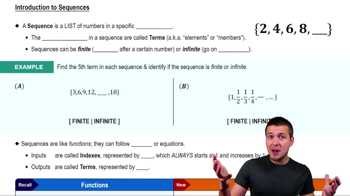
Limits of Sequences

The limit of a sequence is the value that the terms of the sequence approach as the index n goes to infinity. If the terms get arbitrarily close to a specific number, the sequence converges to that limit; otherwise, it diverges.
Recommended video:
Guided course
8:22
Introduction to Sequences

Properties of Exponents and Roots

Understanding how to manipulate expressions with fractional exponents and roots is essential. For example, (1/n)^(1/n) can be rewritten using exponent rules to analyze its behavior as n increases.
Recommended video:
06:21
Properties of Functions

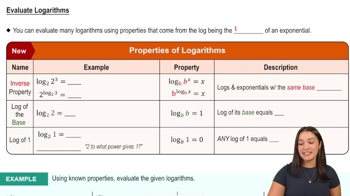
Use of Logarithms in Limit Evaluation

Taking the natural logarithm of a sequence can simplify limit evaluation, especially for expressions involving exponents. By analyzing the limit of the logarithm, one can often find the original sequence's limit using continuity of the exponential function.
Recommended video:
5:14
Evaluate Logarithms