Ch. 10 - Sequences and Infinite Series
Briggs - Calculus: Early Transcendentals 3rd Edition
Briggs3rd EditionCalculus: Early TranscendentalsISBN: 9780136847243Not the one you use?Change textbook
Chapter 10, Problem 10.8.81

11–86. Applying convergence tests Determine whether the following series converge. Justify your answers.


∑ (from k = 1 to ∞)(1 / √(k + 2) – 1 / √k)

Verified step by step guidance
1
Recognize that the series is given by \( \sum_{k=1}^{\infty} \left( \frac{1}{\sqrt{k+2}} - \frac{1}{\sqrt{k}} \right) \). This is a series whose terms are differences of two expressions involving square roots.
Rewrite the general term to see if the series is telescoping. Notice that each term looks like \( a_k = \frac{1}{\sqrt{k+2}} - \frac{1}{\sqrt{k}} \). Try to express the partial sums \( S_n = \sum_{k=1}^n a_k \) to identify cancellation patterns.
Write out the first few terms of the partial sum explicitly: \( S_n = \left( \frac{1}{\sqrt{3}} - \frac{1}{\sqrt{1}} \right) + \left( \frac{1}{\sqrt{4}} - \frac{1}{\sqrt{2}} \right) + \cdots + \left( \frac{1}{\sqrt{n+2}} - \frac{1}{\sqrt{n}} \right) \). Group the positive and negative terms to observe which terms cancel out.
After cancellation, identify the remaining terms in \( S_n \). Typically, in telescoping series, most intermediate terms cancel, leaving only a few terms from the beginning and end of the sequence.
Analyze the limit of the partial sums \( S_n \) as \( n \to \infty \). If the limit exists and is finite, the series converges; otherwise, it diverges.

Verified video answer for a similar problem:

This video solution was recommended by our tutors as helpful for the problem above.
Video duration:
2m
Was this helpful?

Key Concepts

Here are the essential concepts you must grasp in order to answer the question correctly.

Telescoping Series

A telescoping series is one where many terms cancel out when the series is expanded, simplifying the sum to a difference between a few terms. Recognizing this pattern helps in evaluating the limit of partial sums and determining convergence.
Recommended video:
06:00
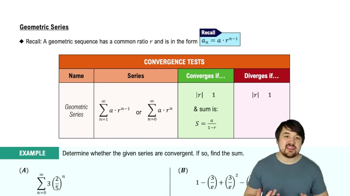
Geometric Series

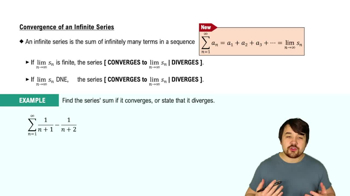
Convergence of Infinite Series

An infinite series converges if the sequence of its partial sums approaches a finite limit. Understanding how to test for convergence, such as by examining partial sums or applying convergence tests, is essential to determine whether the series sums to a finite value.
Recommended video:
06:52
Convergence of an Infinite Series

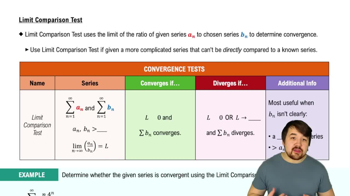
Comparison and Limit Comparison Tests

These tests compare a given series to a known benchmark series to determine convergence or divergence. By comparing terms or their limits, one can infer the behavior of the original series, especially when direct evaluation is complex.
Recommended video:
07:45
Limit Comparison Test