
Ch. 1 - Functions
Briggs - Calculus: Early Transcendentals 3rd Edition
Briggs3rd EditionCalculus: Early TranscendentalsISBN: 9780136847243Not the one you use?Change textbook
Chapter 1, Problem 65d

{Use of Tech} Height and time The height in feet of a baseball hit straight up from the ground with an initial velocity of 64 ft/s is given by h= ƒ(t) = 64t - 16t²  where t is measured in seconds after the hit.


d. At what time is the ball at a height of 30 ft on the way up?

Verified step by step guidance
1
Set the height function equal to 30: \( 64t - 16t^2 = 30 \).
Rearrange the equation to form a standard quadratic equation: \( -16t^2 + 64t - 30 = 0 \).
Simplify the equation by dividing all terms by -2: \( 8t^2 - 32t + 15 = 0 \).
Use the quadratic formula \( t = \frac{-b \pm \sqrt{b^2 - 4ac}}{2a} \) where \( a = 8 \), \( b = -32 \), and \( c = 15 \).
Calculate the discriminant \( b^2 - 4ac \) and solve for \( t \) using the quadratic formula, selecting the solution that corresponds to the ball on the way up.

Verified video answer for a similar problem:

This video solution was recommended by our tutors as helpful for the problem above.
Video duration:
8m
Was this helpful?

Key Concepts

Here are the essential concepts you must grasp in order to answer the question correctly.

Quadratic Functions

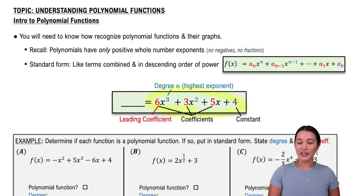
The height function h(t) = 64t - 16t² is a quadratic function, which is a polynomial of degree two. Quadratic functions graph as parabolas, and their general form is ax² + bx + c. Understanding the properties of parabolas, such as their vertex and axis of symmetry, is essential for analyzing the height of the baseball over time.
Recommended video:
6:04
Introduction to Polynomial Functions

Solving Quadratic Equations

To find the time when the baseball reaches a height of 30 ft, we need to solve the equation 64t - 16t² = 30. This involves rearranging the equation into standard form (16t² - 64t + 30 = 0) and applying methods such as factoring, completing the square, or using the quadratic formula. Mastery of these techniques is crucial for finding the roots of the equation.
Recommended video:
5:02
Solving Logarithmic Equations

Interpreting Function Values

Interpreting function values involves understanding what the output of a function represents in a real-world context. In this case, the function h(t) gives the height of the baseball at any time t. Recognizing that we are looking for specific instances when the height equals 30 ft helps in setting up the problem correctly and understanding the physical implications of the solution.
Recommended video:
05:03
Initial Value Problems
Related Practice
Textbook Question

{Use of Tech} Height and time The height in feet of a baseball hit straight up from the ground with an initial velocity of 64 ft/s is given by h= ƒ(t) = 64t - 16t²  where t is measured in seconds after the hit.


e. At what time is the ball at a height of 10 ft on the way down? 

3
views
Textbook Question

Find a trigonometric function ff represented by the graph in the figure. <IMAGE>

Textbook Question

{Use of Tech} Height and time The height in feet of a baseball hit straight up from the ground with an initial velocity of 64 ft/s is given by h= ƒ(t) = 64t - 16t²  where t is measured in seconds after the hit.


a. Is this function one-to-one on the interval 0 ≤ t ≤ 4?

Textbook Question

Prove the following identities.

secθ=1cosθ\(\sec\]\theta\)=\(\frac{1}{\cos\theta}\)

Textbook Question

{Use of Tech} Height and time The height in feet of a baseball hit straight up from the ground with an initial velocity of 64 ft/s is given by h= ƒ(t) = 64t - 16t²  where t is measured in seconds after the hit.


b. Find the inverse function that gives the time t at which the ball is at height h as the ball travels upward. Express your answer in the form t = ƒ⁻¹ (h)

2
views
Textbook Question

{Use of Tech} Height and time The height in feet of a baseball hit straight up from the ground with an initial velocity of 64 ft/s is given by h= ƒ(t) = 64t - 16t²  where t is measured in seconds after the hit.


c. Find the inverse function that gives the time t at which the ball is at height h as the ball travels downward. Express your answer in the form t = ƒ⁻¹ (h)

2
views