
Taxicab fees A taxicab ride costs \$3.50 plus \$2.50 per mile for the first 5 miles, with the rate dropping to \$1.50 per mile after the fifth mile. Let m be the distance (in miles) from the airport to a hotel. Find and graph the piecewise linear function c(m) that represents the cost of taking a taxi from the airport to a hotel m miles away.
Ch. 1 - Functions
Briggs3rd EditionCalculus: Early TranscendentalsISBN: 9780136847243Not the one you use?Change textbook
Chapter 1, Problem 26
The population of a small town was 500 in 2018 and is growing at a rate of 24 people per year. Find and graph the linear population function p(t) that gives the population of the town t years after 2018. Then use this model to predict the population in 2033.
Verified step by step guidance1
Identify the initial population and the rate of growth. The initial population in 2018 is 500, and the growth rate is 24 people per year.
Define the linear population function \( p(t) \) where \( t \) is the number of years after 2018. The function can be expressed as \( p(t) = 500 + 24t \).
To graph the function, plot the initial point (0, 500) on the graph, which represents the population in 2018.
Use the slope, which is 24, to determine another point on the graph. For example, after 1 year (\( t = 1 \)), the population will be \( p(1) = 500 + 24 \times 1 = 524 \). Plot the point (1, 524).
To predict the population in 2033, calculate \( t \) as the number of years from 2018 to 2033, which is 15 years. Substitute \( t = 15 \) into the function \( p(t) = 500 + 24t \) to find the population.

Verified video answer for a similar problem:
This video solution was recommended by our tutors as helpful for the problem above.
Video duration:
3mWas this helpful?
Key Concepts
Here are the essential concepts you must grasp in order to answer the question correctly.
Linear Functions
A linear function is a mathematical expression that describes a straight line when graphed. It is typically represented in the form p(t) = mt + b, where m is the slope (rate of change) and b is the y-intercept (initial value). In this context, the population function will have a constant rate of growth, making it linear.
Recommended video:
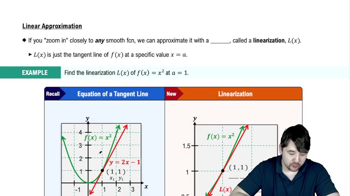
Linearization
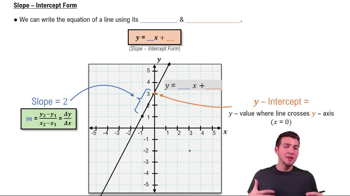
Slope and Intercept
In the context of linear functions, the slope represents the rate of change of the function, while the intercept indicates the starting value. For the population function, the slope is the annual growth rate (24 people per year), and the intercept is the initial population (500 in 2018). Understanding these components is crucial for constructing the function.
Recommended video:
Guided course
Slope-Intercept Form
Graphing Linear Functions
Graphing a linear function involves plotting points that satisfy the function's equation and connecting them to form a straight line. For the population function, you would plot the population values against the years since 2018. This visual representation helps in understanding trends and making predictions, such as estimating the population in 2033.
Recommended video:
Linearization
Related Practice
Textbook Question
Textbook Question
Where do inverses exist? Use analytical and/or graphical methods to determine the largest possible sets of points on which the following functions have an inverse.
{Use of Tech} ƒ(x) = 1/(x-5)
5
views
Textbook Question
Find the inverse function (on the given interval, if specified) and graph both and on the same set of axes. Check your work by looking for the required symmetry in the graphs.
Textbook Question
Evaluating trigonometric functions Without using a calculator, evaluate the following expressions or state that the quantity is undefined.
sec (7π/6)
5
views
Textbook Question
Evaluating trigonometric functions Without using a calculator, evaluate the following expressions or state that the quantity is undefined.
tan (15π/4)
5
views
Textbook Question
Graphing equations Graph the following equations.
c. x² + 2x + y² + 4y + 1 = 0
4
views
