Ch. 1 - Functions
Briggs - Calculus: Early Transcendentals 3rd Edition
Briggs3rd EditionCalculus: Early TranscendentalsISBN: 9780136847243Not the one you use?Change textbook
Chapter 1, Problem 85

Symmetry Determine whether the graphs of the following equations and functions are symmetric about the x-axis, the y-axis, or the origin. Check your work by graphing.
ƒ(x)=xxƒ(x) = x |x|

Verified step by step guidance
1
Step 1: Understand the function given, \( f(x) = x |x| \). This function involves the absolute value of \( x \), which affects its symmetry properties.
Step 2: Test for symmetry about the y-axis. Replace \( x \) with \( -x \) in the function to get \( f(-x) = (-x) |-x| = -x |x| \). Since \( f(-x) \neq f(x) \), the function is not symmetric about the y-axis.
Step 3: Test for symmetry about the x-axis. For this, check if \( -f(x) = f(x) \). Since \( -f(x) = -x |x| \) and \( f(x) = x |x| \), \( -f(x) \neq f(x) \), so the function is not symmetric about the x-axis.
Step 4: Test for symmetry about the origin. Check if \( f(-x) = -f(x) \). We have \( f(-x) = -x |x| \) and \( -f(x) = -x |x| \). Since \( f(-x) = -f(x) \), the function is symmetric about the origin.
Step 5: Verify your findings by graphing the function \( f(x) = x |x| \). The graph should confirm that the function is symmetric about the origin, as it will look the same when rotated 180 degrees around the origin.

Verified video answer for a similar problem:

This video solution was recommended by our tutors as helpful for the problem above.
Video duration:
4m
Was this helpful?

Key Concepts

Here are the essential concepts you must grasp in order to answer the question correctly.

Symmetry in Graphs

Symmetry in graphs refers to the property where a graph remains unchanged under certain transformations. A graph is symmetric about the y-axis if replacing x with -x yields the same function value, indicating even symmetry. It is symmetric about the x-axis if replacing y with -y gives the same x value, and it is symmetric about the origin if replacing both x and y with their negatives results in the same function.
Recommended video:
06:15
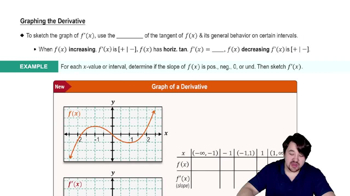
Graphing The Derivative

Absolute Value Function

The absolute value function, denoted as |x|, outputs the non-negative value of x regardless of its sign. This function is crucial in determining symmetry because it affects the behavior of the graph, particularly in how it reflects across the axes. For example, the function f(x) = x|x| combines linear and absolute value characteristics, influencing its symmetry properties.
Recommended video:
05:03
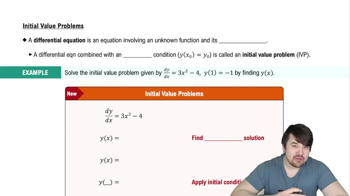
Initial Value Problems

Graphing Techniques

Graphing techniques involve plotting points on a coordinate plane to visualize the behavior of a function. This process helps in identifying symmetry and other characteristics of the graph. By graphing the function f(x) = x|x|, one can observe its shape and confirm its symmetry properties, providing a practical method to validate theoretical findings.
Recommended video:
06:15
Graphing The Derivative