
Ch. 1 - Functions
Briggs - Calculus: Early Transcendentals 3rd Edition
Briggs3rd EditionCalculus: Early TranscendentalsISBN: 9780136847243Not the one you use?Change textbook
Chapter 1, Problem 1.96b

Inverse of composite functions


b. Let g(x) = x² + 1 and h(x) = √x. Consider the composite function ƒ(x) = g(h(x)). Find ƒ⁻¹ directly and then express it in terms of g⁻¹ and h⁻¹

Verified step by step guidance
1
Start by finding the composite function \( f(x) = g(h(x)) \). Substitute \( h(x) = \sqrt{x} \) into \( g(x) = x^2 + 1 \) to get \( f(x) = g(\sqrt{x}) = (\sqrt{x})^2 + 1 = x + 1 \).
To find the inverse \( f^{-1}(x) \), start with the equation \( y = x + 1 \) and solve for \( x \).
Rearrange the equation \( y = x + 1 \) to express \( x \) in terms of \( y \): \( x = y - 1 \).
Thus, the inverse function is \( f^{-1}(x) = x - 1 \).
Now, express \( f^{-1} \) in terms of \( g^{-1} \) and \( h^{-1} \). Since \( f(x) = g(h(x)) \), we have \( f^{-1}(x) = h^{-1}(g^{-1}(x)) \). Given \( g(x) = x^2 + 1 \), \( g^{-1}(x) = \sqrt{x - 1} \), and \( h(x) = \sqrt{x} \), \( h^{-1}(x) = x^2 \). Therefore, \( f^{-1}(x) = h^{-1}(g^{-1}(x)) = (\sqrt{x - 1})^2 = x - 1 \).

Verified video answer for a similar problem:

This video solution was recommended by our tutors as helpful for the problem above.
Video duration:
5m
Was this helpful?

Key Concepts

Here are the essential concepts you must grasp in order to answer the question correctly.

Composite Functions

A composite function is formed when one function is applied to the result of another function. In this case, if we have functions g(x) and h(x), the composite function f(x) = g(h(x)) means we first apply h to x and then apply g to the result of h. Understanding how to manipulate and analyze composite functions is crucial for finding their inverses.
Recommended video:
3:48
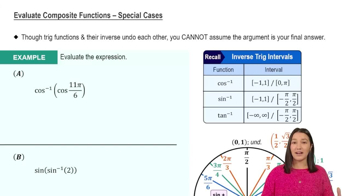
Evaluate Composite Functions - Special Cases

Inverse Functions

An inverse function essentially reverses the effect of the original function. If f(x) takes an input x and produces an output y, then the inverse function f⁻¹(y) takes y back to x. To find the inverse of a composite function, we often need to find the inverses of the individual functions involved and apply them in the reverse order.
Recommended video:
4:49
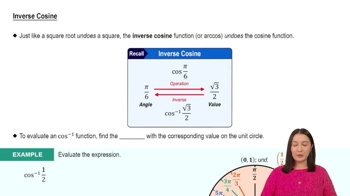
Inverse Cosine

Function Notation and Operations

Understanding function notation and operations is essential for working with functions and their inverses. This includes knowing how to denote functions, apply them, and manipulate their outputs. In the context of the question, expressing the inverse of the composite function in terms of the inverses of g and h requires a solid grasp of how to combine and rearrange these functions correctly.
Recommended video:
7:24
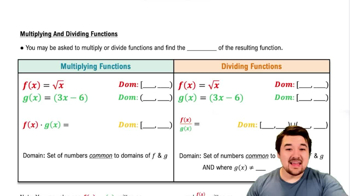
Multiplying & Dividing Functions