Ch. 1 - Functions
Briggs - Calculus: Early Transcendentals 3rd Edition
Briggs3rd EditionCalculus: Early TranscendentalsISBN: 9780136847243Not the one you use?Change textbook
Chapter 1, Problem 1.2.10

How do you obtain the graph of y=3f(x)y=-3f\(\left\)(x\(\right\)) from the graph of y=f(x)y=f\(\left\)(x\(\right\))?

Verified step by step guidance
1
Start with the graph of y = f(x). This is your original function graph.
The transformation y = -3f(x) involves two operations: a vertical reflection and a vertical stretch.
First, apply a vertical reflection across the x-axis. This changes the graph of y = f(x) to y = -f(x), flipping it upside down.
Next, apply a vertical stretch by a factor of 3. This means you multiply all y-values of the graph by 3, making the graph taller by stretching it away from the x-axis.
Combine these transformations to obtain the final graph of y = -3f(x), which is the vertically stretched and reflected version of the original graph y = f(x).

Verified video answer for a similar problem:

This video solution was recommended by our tutors as helpful for the problem above.
Video duration:
5m
Was this helpful?

Key Concepts

Here are the essential concepts you must grasp in order to answer the question correctly.

Function Transformation

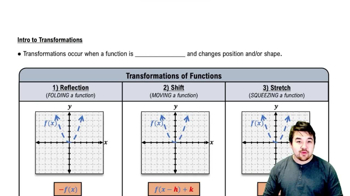
Function transformation refers to the process of altering the graph of a function through various operations, such as shifting, stretching, or reflecting. In this case, the transformation involves multiplying the function f(x) by -3, which results in a vertical stretch by a factor of 3 and a reflection across the x-axis.
Recommended video:
5:25
Intro to Transformations

Vertical Stretch and Reflection

A vertical stretch occurs when the output values of a function are multiplied by a factor greater than 1, making the graph taller. A reflection across the x-axis flips the graph upside down. The transformation y = -3f(x) combines both effects: it stretches the graph of f(x) vertically by a factor of 3 and reflects it over the x-axis.
Recommended video:
5:30
Foci and Vertices of an Ellipse

Graphing Techniques

Graphing techniques involve methods for accurately plotting the transformations of functions. To graph y = -3f(x), one can start with the original graph of y = f(x), apply the vertical stretch by multiplying the y-values by 3, and then reflect the resulting points across the x-axis to obtain the final graph.
Recommended video:
06:15
Graphing The Derivative