
Ch. 1 - Functions
Briggs - Calculus: Early Transcendentals 3rd Edition
Briggs3rd EditionCalculus: Early TranscendentalsISBN: 9780136847243Not the one you use?Change textbook
Chapter 1, Problem 30

Graphing functions Sketch a graph of each function.


ƒ(x) = { 2x if x ≤ 1 , 3-x if x > 1

Verified step by step guidance
1
Identify the type of function: This is a piecewise function, which means it is defined by different expressions depending on the value of x.
Determine the domain for each piece: The function is defined as f(x) = 2x for x ≤ 1 and f(x) = 3 - x for x > 1.
Sketch the first piece: For f(x) = 2x when x ≤ 1, this is a linear function with a slope of 2. Plot the line starting from x = -∞ to x = 1, including the point (1, 2) as a solid dot since x = 1 is included.
Sketch the second piece: For f(x) = 3 - x when x > 1, this is also a linear function with a slope of -1. Plot the line starting just after x = 1, with an open circle at (1, 2) since x = 1 is not included in this piece, and continue to x = ∞.
Combine the pieces: Ensure the graph is continuous at x = 1 by checking the values of both pieces at this point. The first piece ends at (1, 2) and the second piece starts just after (1, 2), so the graph is not continuous at x = 1.

Verified video answer for a similar problem:

This video solution was recommended by our tutors as helpful for the problem above.
Video duration:
6m
Was this helpful?

Key Concepts

Here are the essential concepts you must grasp in order to answer the question correctly.

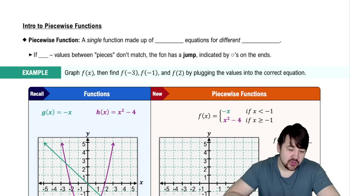
Piecewise Functions

A piecewise function is defined by different expressions based on the input value. In this case, the function ƒ(x) has two distinct rules: 2x for x values less than or equal to 1, and 3-x for x values greater than 1. Understanding how to evaluate and graph each piece separately is crucial for accurately representing the overall function.
Recommended video:
05:36
Piecewise Functions

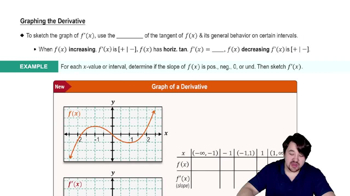
Graphing Techniques

Graphing techniques involve plotting points and understanding the behavior of functions across their domains. For piecewise functions, it is important to identify the points where the function changes its rule, and to ensure continuity or discontinuity at those points. This includes determining the endpoints and whether they are included in the graph.
Recommended video:
06:15
Graphing The Derivative

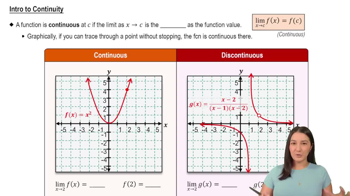
Continuity and Discontinuity

Continuity refers to a function being unbroken at a point, meaning the function's value at that point matches the limit as it approaches from either side. In the case of the given piecewise function, checking continuity at x = 1 is essential, as it determines whether the graph has a jump or is smooth at that transition point.
Recommended video:
05:34
Intro to Continuity
Related Practice
Textbook Question

Taxicab fees A taxicab ride costs \$3.50 plus \$2.50 per mile for the first 5 miles, with the rate dropping to \$1.50 per mile after the fifth mile. Let m be the distance (in miles) from the airport to a hotel. Find and graph the piecewise linear function c(m) that represents the cost of taking a taxi from the airport to a hotel m miles away.

Textbook Question

Find the inverse function (on the given interval, if specified) and graph both ff and f1f^{-1} on the same set of axes. Check your work by looking for the required symmetry in the graphs.

f(x)=x2+4f\(\left\)(x\(\right\))=x^2+4, for x0x\(\geq{0}\)

Textbook Question

Piecewise linear functions Graph the following functions.

f(x)={3x1, if x02x1, if x>0f\(\left\)(x\(\right\))=\(\begin{cases}\)3x-1\(\frac{}{}\),\(\text{ if }\)x\(\le\)0\\ -2x-1,\(\text{ if }\)x>0\(\end{cases}\)

Textbook Question

Find the inverse function (on the given interval, if specified) and graph both ff and f1f^{-1} on the same set of axes. Check your work by looking for the required symmetry in the graphs.

f(x)=84xf\(\left\)(x\(\right\))=8-4x

Textbook Question

{Use of Tech} Launching a rocket A small rocket is launched vertically upward from the edge of a cliff 8080 ft above the ground at a speed of 9696 ft/s. Its height (in feet) above the ground is given by h(t)=16t2+96t+80h\(\left\)(t\(\right\))=-16t^2+96t+80, where tt represents time measured in seconds.

a. Assuming the rocket is launched at t=0t=0, what is an appropriate domain for hh?

Textbook Question

Graphing equations Graph the following equations. 


c. x² + 2x + y² + 4y + 1 = 0

4
views