Ch. 1 - Functions
Briggs - Calculus: Early Transcendentals 3rd Edition
Briggs3rd EditionCalculus: Early TranscendentalsISBN: 9780136847243Not the one you use?Change textbook
Chapter 1, Problem 1.85

Finding all inverses Find all the inverses associated with the following functions, and state their domains.


ƒ(x) = x² -2x + 6

Verified step by step guidance
1
Step 1: Determine if the function is one-to-one.> To find the inverse of a function, it must be one-to-one. The function \( f(x) = x^2 - 2x + 6 \) is a quadratic function, which is not one-to-one over all real numbers. Therefore, we need to restrict the domain to make it one-to-one. Quadratic functions are one-to-one on intervals where they are either strictly increasing or strictly decreasing. Since the parabola opens upwards, we can consider the vertex to find the interval. The vertex form of a quadratic function is \( f(x) = a(x-h)^2 + k \), where \( (h, k) \) is the vertex.
Step 2: Find the vertex of the quadratic function.> The vertex of \( f(x) = x^2 - 2x + 6 \) can be found using the formula \( h = -\frac{b}{2a} \). Here, \( a = 1 \) and \( b = -2 \), so \( h = -\frac{-2}{2 \times 1} = 1 \). Substitute \( x = 1 \) into the function to find \( k \): \( f(1) = 1^2 - 2 \times 1 + 6 = 5 \). Thus, the vertex is \( (1, 5) \).
Step 3: Restrict the domain.> To make the function one-to-one, restrict the domain to either \( x \leq 1 \) or \( x \geq 1 \). This will ensure the function is either strictly increasing or strictly decreasing. For this problem, let's choose \( x \geq 1 \) for simplicity, where the function is increasing.
Step 4: Solve for the inverse function.> To find the inverse, swap \( x \) and \( y \) in the equation \( y = x^2 - 2x + 6 \) and solve for \( y \). This gives \( x = y^2 - 2y + 6 \). Rearrange to form a quadratic equation in terms of \( y \): \( y^2 - 2y + (6 - x) = 0 \). Use the quadratic formula \( y = \frac{-b \pm \sqrt{b^2 - 4ac}}{2a} \) to solve for \( y \). Here, \( a = 1 \), \( b = -2 \), and \( c = 6 - x \).
Step 5: State the inverse function and its domain.> The inverse function will be \( f^{-1}(x) = 1 + \sqrt{x - 5} \) for \( x \geq 5 \), since we chose the domain \( x \geq 1 \) for the original function. The domain of the inverse function is determined by the range of the original function, which is \( y \geq 5 \).

Verified video answer for a similar problem:

This video solution was recommended by our tutors as helpful for the problem above.
Video duration:
5m
Was this helpful?

Key Concepts

Here are the essential concepts you must grasp in order to answer the question correctly.

Inverse Functions

An inverse function essentially reverses the effect of the original function. If a function f takes an input x and produces an output y, the inverse function f⁻¹ takes y back to x. To find an inverse, one typically swaps the roles of x and y in the equation and solves for y.
Recommended video:
4:49
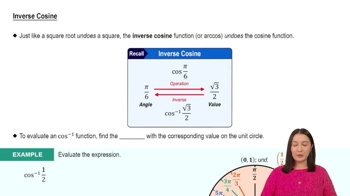
Inverse Cosine

Domain and Range

The domain of a function is the set of all possible input values (x-values) that the function can accept, while the range is the set of all possible output values (y-values). When finding the inverse of a function, the domain of the original function becomes the range of the inverse, and vice versa.
Recommended video:
5:10
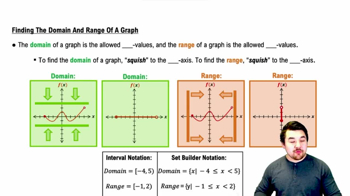
Finding the Domain and Range of a Graph

Completing the Square

Completing the square is a method used to transform a quadratic function into a perfect square trinomial, which makes it easier to analyze and find its vertex. This technique is particularly useful for rewriting the function in vertex form, aiding in the identification of its inverse and determining its domain.
Recommended video:
3:03
Trig Values in Quadrants II, III, & IV Example 1