Ch. 1 - Functions
Briggs - Calculus: Early Transcendentals 3rd Edition
Briggs3rd EditionCalculus: Early TranscendentalsISBN: 9780136847243Not the one you use?Change textbook
Chapter 1, Problem 1.3.37

Find the inverse f1(x)f^{-1}\(\left\)(x\(\right\)) of each function (on the given interval, if specified).
f(x)=ln(3x+1)f\(\left\)(x\(\right\))=\(\ln\]\left\)(3x+1\(\right\))

Verified step by step guidance
1
Start by setting the function equal to y: y = \(\ln\)(3x + 1). This is the first step in finding the inverse function.
To find the inverse, we need to solve for x in terms of y. Begin by exponentiating both sides to eliminate the natural logarithm: e^y = 3x + 1.
Next, isolate x by subtracting 1 from both sides: e^y - 1 = 3x.
Divide both sides by 3 to solve for x: x = \(\frac{e^y - 1}{3}\).
Finally, replace y with x to express the inverse function: f^{-1}(x) = \(\frac{e^x - 1}{3}\). This is the inverse of the original function.

Verified video answer for a similar problem:

This video solution was recommended by our tutors as helpful for the problem above.
Video duration:
3m
Was this helpful?

Key Concepts

Here are the essential concepts you must grasp in order to answer the question correctly.

Inverse Functions

An inverse function essentially reverses the effect of the original function. If a function f takes an input x and produces an output y, the inverse function f^{-1} takes y as input and returns x. For a function to have an inverse, it must be one-to-one, meaning each output is produced by exactly one input.
Recommended video:
4:49
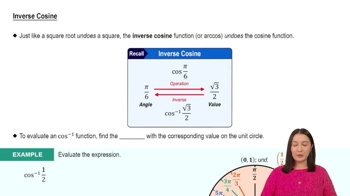
Inverse Cosine

Natural Logarithm

The natural logarithm, denoted as ln, is the logarithm to the base e, where e is approximately 2.71828. It is a fundamental function in calculus, particularly in solving equations involving exponential growth or decay. The natural logarithm is the inverse of the exponential function, making it crucial for finding inverses of functions that include ln.
Recommended video:
05:18
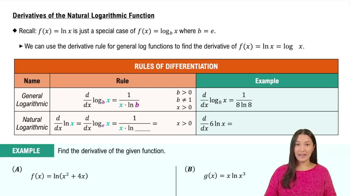
Derivative of the Natural Logarithmic Function

Domain and Range

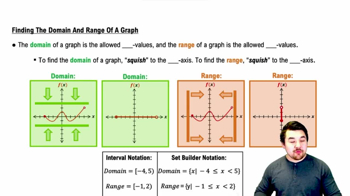
The domain of a function is the set of all possible input values (x-values) that the function can accept, while the range is the set of all possible output values (y-values) that the function can produce. Understanding the domain and range is essential when finding the inverse of a function, as the range of the original function becomes the domain of its inverse.
Recommended video:
5:10
Finding the Domain and Range of a Graph