Ch. 1 - Functions
Briggs - Calculus: Early Transcendentals 3rd Edition
Briggs3rd EditionCalculus: Early TranscendentalsISBN: 9780136847243Not the one you use?Change textbook
Chapter 1, Problem 32a

Draining a tank (Torricelli’s law) A cylindrical tank with a cross-sectional area of 1010 m2 is filled to a depth of 2525 m with water. At t=0t=0 s, a drain in the bottom of the tank with an area of 11  is opened, allowing water to flow out of the tank. The depth of water in the tank (in meters) at time t0t\(\geq{0}\) is d(t)=(50.22t)2d\(\left\)(t\(\right\))=\(\left\)(5-0.22t\(\right\))^2.
a. Check that d(0)=25d\(\left\)(0\(\right\))=25, as specified.

Verified step by step guidance
1
Identify the function given for the depth of water in the tank: \( d(t) = (5 - 0.22t)^2 \).
To verify \( d(0) = 25 \), substitute \( t = 0 \) into the function \( d(t) \).
Calculate \( d(0) = (5 - 0.22 \times 0)^2 \).
Simplify the expression: \( d(0) = (5 - 0)^2 = 5^2 \).
Compute \( 5^2 \) to confirm that \( d(0) = 25 \), which matches the specified initial condition.

Verified video answer for a similar problem:

This video solution was recommended by our tutors as helpful for the problem above.
Video duration:
3m
Was this helpful?

Key Concepts

Here are the essential concepts you must grasp in order to answer the question correctly.

Torricelli's Law

Torricelli's Law states that the speed of fluid flowing out of an orifice under the force of gravity is proportional to the square root of the height of the fluid above the opening. This principle is crucial for understanding how the depth of water in a tank changes over time as it drains. The law can be mathematically expressed as v = √(2gh), where v is the exit speed, g is the acceleration due to gravity, and h is the height of the fluid.
Recommended video:
10:44
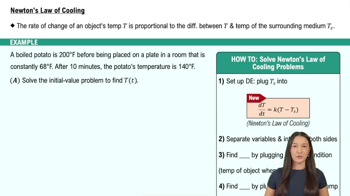
Newton's Law of Cooling

Differential Equations

Differential equations are mathematical equations that relate a function to its derivatives. In the context of draining a tank, they are used to model the rate of change of the water depth over time. The equation derived from Torricelli's Law can be expressed as a first-order differential equation, which can be solved to find the function describing the depth of water as a function of time.
Recommended video:
07:39
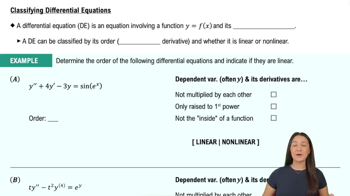
Classifying Differential Equations

Initial Conditions

Initial conditions are the values that specify the state of a system at the beginning of a process. In this problem, the initial condition is that the depth of water in the tank at time t=0 is 25 meters. This information is essential for solving the differential equation, as it allows for the determination of the specific solution that describes the water depth over time.
Recommended video:
05:03
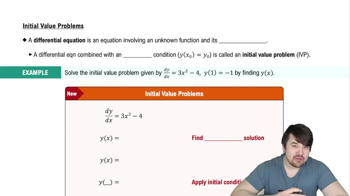
Initial Value Problems
Related Practice
Textbook Question

Find the inverse function (on the given interval, if specified) and graph both ff and f1f^{-1} on the same set of axes. Check your work by looking for the required symmetry in the graphs.

f(x)=x2+4f\(\left\)(x\(\right\))=x^2+4, for x0x\(\geq{0}\)

Textbook Question

Draining a tank (Torricelli’s law) A cylindrical tank with a cross-sectional area of 1010 m2 is filled to a depth of 2525 m with water. At t=0t=0 s, a drain in the bottom of the tank with an area of 11  is opened, allowing water to flow out of the tank. The depth of water in the tank (in meters) at time t0t\(\geq{0}\) is d(t)=(50.22t)2d\(\left\)(t\(\right\))=\(\left\)(5-0.22t\(\right\))^2.

b. At what time is the tank empty?

1
views
Textbook Question

Piecewise linear functions Graph the following functions.

f(x)={3x1, if x02x1, if x>0f\(\left\)(x\(\right\))=\(\begin{cases}\)3x-1\(\frac{}{}\),\(\text{ if }\)x\(\le\)0\\ -2x-1,\(\text{ if }\)x>0\(\end{cases}\)

Textbook Question

Composite functions and notation

Let ƒ(x)= x² - 4 , g(x) = x³ and F(x) = 1/(x-3). Simplify or evaluate the following expressions.

g(1/z)

1
views
Textbook Question

{Use of Tech} Launching a rocket A small rocket is launched vertically upward from the edge of a cliff 8080 ft above the ground at a speed of 9696 ft/s. Its height (in feet) above the ground is given by h(t)=16t2+96t+80h\(\left\)(t\(\right\))=-16t^2+96t+80, where tt represents time measured in seconds.

a. Assuming the rocket is launched at t=0t=0, what is an appropriate domain for hh?

Textbook Question

Draining a tank (Torricelli’s law) A cylindrical tank with a cross-sectional area of 1010 m2 is filled to a depth of 2525 m with water. At t=0t=0 s, a drain in the bottom of the tank with an area of 11  is opened, allowing water to flow out of the tank. The depth of water in the tank (in meters) at time t0t\(\geq{0}\) is d(t)=(50.22t)2d\(\left\)(t\(\right\))=\(\left\)(5-0.22t\(\right\))^2.

c. What is an appropriate domain for dd?