Skip to main content
Calculus
My Course
Learn
Exam Prep
AI Tutor
Study Guides
Textbook Solutions
Flashcards
Explore
Try the app
My Course
Learn
Exam Prep
AI Tutor
Study Guides
Textbook Solutions
Flashcards
Explore
Try the app
Back
The First Derivative Test quiz
You can tap to flip the card.
What does a positive value of the derivative f'(x) indicate about the function f(x)?
You can tap to flip the card.
👆
What does a positive value of the derivative f'(x) indicate about the function f(x)?
A positive derivative means the function is increasing at that point.
Track progress
Control buttons has been changed to "navigation" mode.
1/15
Related flashcards
Related practice
Recommended videos
The First Derivative Test definitions
The First Derivative Test
15 Terms
The First Derivative Test
5. Graphical Applications of Derivatives
3 problems
Topic
Justin
Concavity
5. Graphical Applications of Derivatives
3 problems
Topic
Jonathan
5. Graphical Applications of Derivatives
7 topics
13 problems
Chapter
Ernest
11:22
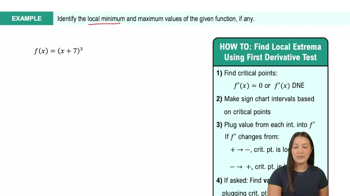
The First Derivative Test: Finding Local Extrema Example 3
8
views
04:00
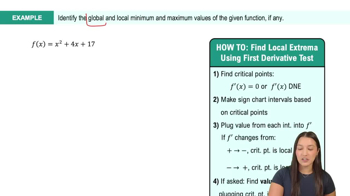
The First Derivative Test: Finding Local Extrema Example 2
5
views
05:00
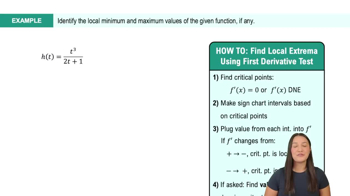
The First Derivative Test: Finding Local Extrema Example 4
3
views
Terms in this set (15)
Hide definitions
What does a positive value of the derivative f'(x) indicate about the function f(x)?
A positive derivative means the function is increasing at that point.
How can you determine if a function is increasing or decreasing at a specific value of x?
Plug the value into the derivative; if the result is positive, the function is increasing, and if negative, it's decreasing.
What are critical points of a function?
Critical points are where the derivative is zero or does not exist.
How do you find the intervals where a function is increasing or decreasing?
Find the critical points, create intervals based on them, and test the sign of the derivative within each interval.
What is a sign chart and how is it used?
A sign chart is a number line split at critical points, used to test the sign of the derivative in each interval.
What does it mean if the derivative is negative over an interval?
The function is decreasing throughout that interval.
What is the first derivative test used for?
It is used to determine the locations of local maxima and minima by analyzing sign changes of the derivative.
What does a change in the derivative from positive to negative at a critical point indicate?
It indicates a local maximum at that critical point.
What does a change in the derivative from negative to positive at a critical point indicate?
It indicates a local minimum at that critical point.
What does it mean if the sign of the derivative does not change at a critical point?
There is no local extremum (maximum or minimum) at that point.
How do you find the value of a local maximum or minimum once you know its location?
Plug the critical point back into the original function to find the corresponding function value.
Why is it sufficient to test only one value in each interval when using the first derivative test?
Because the sign of the derivative does not change within an interval between critical points.
What is the first step in applying the first derivative test to a function?
Find the critical points by setting the derivative equal to zero or finding where it does not exist.
If f'(x) = 0 at x = c, and the sign of f'(x) changes from positive to negative at c, what can you conclude?
There is a local maximum at x = c.
If f'(x) = 0 at x = c, and the sign of f'(x) changes from negative to positive at c, what can you conclude?
There is a local minimum at x = c.
 BackBack
 11:22
11:22