Skip to main content
Calculus
My Course
Learn
Exam Prep
AI Tutor
Study Guides
Textbook Solutions
Flashcards
Explore
Try the app
My Course
Learn
Exam Prep
AI Tutor
Study Guides
Textbook Solutions
Flashcards
Explore
Try the app
Back
Separable Differential Equations definitions
You can tap to flip the card.
Separable Differential Equation
You can tap to flip the card.
👆
Separable Differential Equation
An equation where the derivative can be written as a product of a function of one variable and a function of another.
Track progress
Control buttons has been changed to "navigation" mode.
1/15
Related flashcards
Related practice
Recommended videos
Separable Differential Equations quiz #1
Separable Differential Equations
10 Terms
Separable Differential Equations
13. Intro to Differential Equations
5 problems
Topic
Ally
Euler's Method
13. Intro to Differential Equations
5 problems
Topic
Ally
13. Intro to Differential Equations
4 topics
12 problems
Chapter
Ernest
10:44
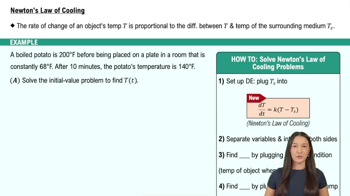
Newton's Law of Cooling
1
views
05:28
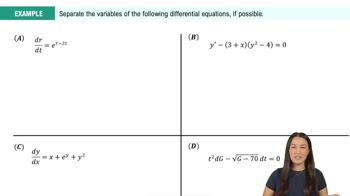
Separation of Variables Example 1
1
views
04:55
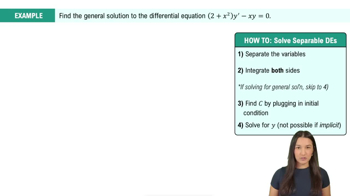
Solving Separable Differential Equations Example 2
5
views
Terms in this set (15)
Hide definitions
Separable Differential Equation
An equation where the derivative can be written as a product of a function of one variable and a function of another.
Variable Separation
The process of rearranging an equation so that all terms involving one variable are on one side with its differential.
Integration
A step used after separating variables to find the general or particular solution to a differential equation.
Constant of Integration
An arbitrary value added after integrating, determined by initial conditions in specific problems.
Initial Condition
A given value for the function at a specific point, used to find the particular solution of a differential equation.
General Solution
A solution to a differential equation that contains an arbitrary constant, representing a family of functions.
Particular Solution
A specific solution to a differential equation found by applying initial conditions to the general solution.
Exponential Growth
A process where a quantity increases at a rate proportional to its current value, modeled by a positive growth constant.
Exponential Decay
A process where a quantity decreases at a rate proportional to its current value, modeled by a negative growth constant.
Growth Constant
A parameter indicating the rate of exponential change; positive for growth, negative for decay.
Newton's Law of Cooling
A model describing temperature change as proportional to the difference between an object's temperature and its environment.
Surrounding Medium
The environment whose temperature influences the rate of temperature change in Newton's law of cooling.
Implicit Solution
A solution where the dependent variable cannot be isolated explicitly, often left in a combined form.
Natural Logarithm
A mathematical function, often appearing in solutions after integrating expressions involving 1 over a variable.
Differential Equation
An equation involving derivatives that describes how a quantity changes with respect to another variable.
 BackBack
 10:44
10:44