Skip to main content
Calculus
My Course
Learn
Exam Prep
AI Tutor
Study Guides
Textbook Solutions
Flashcards
Explore
Try the app
My Course
Learn
Exam Prep
AI Tutor
Study Guides
Textbook Solutions
Flashcards
Explore
Try the app
Back
Review of Factorials quiz
You can tap to flip the card.
What mathematical operation does the exclamation point represent when placed after a number or variable?
You can tap to flip the card.
👆
What mathematical operation does the exclamation point represent when placed after a number or variable?
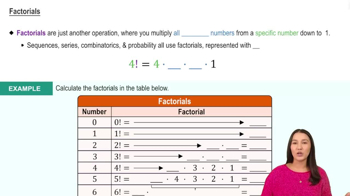
It represents the factorial operation, which multiplies all whole numbers from the given number down to one.
Track progress
Control buttons has been changed to "navigation" mode.
1/15
Related flashcards
Related practice
Recommended videos
Review of Factorials definitions
Review of Factorials
15 Terms
Review of Factorials
14. Sequences & Series
5 problems
Topic
Ernest
Series
14. Sequences & Series
5 problems
Topic
Ernest
14. Sequences & Series
4 topics
12 problems
Chapter
Ernest
5:22
Factorials
3
views
Terms in this set (15)
Hide definitions
What mathematical operation does the exclamation point represent when placed after a number or variable?
It represents the factorial operation, which multiplies all whole numbers from the given number down to one.
How do you calculate 4 factorial (4!)?
Multiply 4 × 3 × 2 × 1, which equals 24.
What is the value of 1 factorial (1!)?
1 factorial is equal to 1.
How do you compute 2 factorial (2!)?
Multiply 2 × 1, which equals 2.
What is the value of 3 factorial (3!)?
3 factorial is equal to 6 (3 × 2 × 1).
What is the value of 5 factorial (5!)?
5 factorial is equal to 120 (5 × 4 × 3 × 2 × 1).
What pattern do you notice when calculating consecutive factorials?
Each factorial is the previous factorial multiplied by the new number.
How can you express n factorial (n!) in terms of (n-1)!?
n! = n × (n-1)!
How can you simplify 4 × 3 factorial (4 × 3!)?
It is equal to 4 factorial (4!), which is 24.
How do you simplify 100 factorial divided by 99 factorial (100! / 99!)?
It simplifies to 100, since 100! = 100 × 99! and 99! cancels out.
What is the value of zero factorial (0!)?
Zero factorial is defined as 1.
Why is 0! defined as 1?
It follows from the factorial formula and is necessary for consistency in combinatorics and probability.
In which areas of mathematics are factorials commonly used?
Factorials are commonly used in sequences, series, combinatorics, and probability.
What is the result of 6 factorial (6!)?
6 factorial is 720 (6 × 5 × 4 × 3 × 2 × 1).
How does the formula n! = n × (n-1)! help simplify factorial expressions?
It allows you to break down large factorials into smaller ones, making calculations easier.
 BackBack
 5:22
5:22