Skip to main content
Calculus
My Course
Learn
Exam Prep
AI Tutor
Study Guides
Textbook Solutions
Flashcards
Explore
Try the app
My Course
Learn
Exam Prep
AI Tutor
Study Guides
Textbook Solutions
Flashcards
Explore
Try the app
Back
Euler's Method definitions
You can tap to flip the card.
Euler's Method
You can tap to flip the card.
👆
Euler's Method
An iterative technique using multiple short tangent lines to approximate function values more accurately than a single tangent line.
Track progress
Control buttons has been changed to "navigation" mode.
1/15
Related flashcards
Related practice
Recommended videos
Euler's Method quiz
Euler's Method
15 Terms
Euler's Method
13. Intro to Differential Equations
5 problems
Topic
Ally
Separable Differential Equations
13. Intro to Differential Equations
5 problems
Topic
Ally
13. Intro to Differential Equations
4 topics
12 problems
Chapter
Ernest
07:33
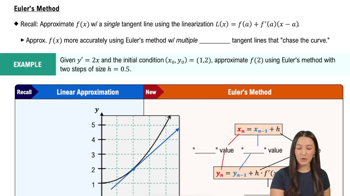
Euler's Method
2
views
08:09
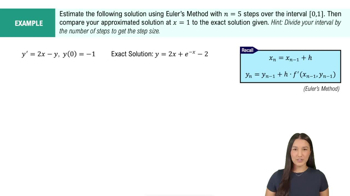
Euler's Method Example 1
Terms in this set (15)
Hide definitions
Euler's Method
An iterative technique using multiple short tangent lines to approximate function values more accurately than a single tangent line.
Step Size
A fixed increment added to the x-value at each iteration, controlling the accuracy and number of steps in the approximation.
Tangent Line
A straight line that locally touches a curve at a point, matching the curve's slope at that location.
Initial Condition
A starting point for x and y values, providing the base for iterative calculations in approximation methods.
Differential Equation
An equation involving a function and its derivative, used to describe the relationship between variables in the method.
Linear Approximation
A method using a single tangent line to estimate a function's value near a known point.
Derivative
A measure of how a function changes as its input changes, used to determine the slope for tangent lines.
Iteration
A repeated process of updating x and y values using previous results and the method's formula.
Approximation
An estimated value of a function at a specific point, obtained through a numerical method.
Table
An organized arrangement of x and y values at each step, aiding in tracking the iterative process.
Function Value
The output of a function for a given input, often the target of the approximation process.
Slope
A numerical value representing the steepness of a tangent line, determined by the derivative at a point.
Point
A specific location on a graph defined by x and y coordinates, marking each step in the method.
Accuracy
The closeness of an approximation to the actual function value, improved by smaller step sizes.
Graph
A visual representation of points and lines showing the progression of approximations alongside the actual curve.
 BackBack
 07:33
07:33