Back

Derivatives of Inverse Trigonometric Functions definitions

Control buttons has been changed to "navigation" mode.
1/14
  • Inverse Sine

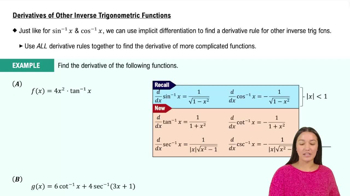
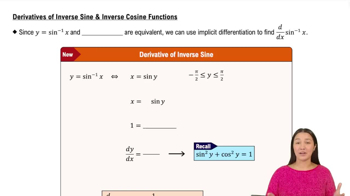
    A function whose derivative is 1 divided by the square root of 1 minus the input squared, with input restricted between -1 and 1.
  • Inverse Cosine

    A function whose derivative is negative 1 over the square root of 1 minus the input squared, with input restricted between -1 and 1.
  • Inverse Tangent

    A function whose derivative is 1 divided by 1 plus the input squared, defined for all real numbers.
  • Inverse Cotangent

    A function whose derivative is negative 1 over 1 plus the input squared, defined for all real numbers.
  • Inverse Secant

    A function whose derivative is 1 over the absolute value of the input times the square root of the input squared minus 1, with input greater than 1 or less than -1.
  • Inverse Cosecant

    A function whose derivative is negative 1 over the absolute value of the input times the square root of the input squared minus 1, with input greater than 1 or less than -1.
  • Implicit Differentiation

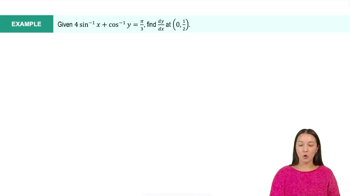
    A technique for finding derivatives when a function is defined implicitly, often used for inverse trigonometric functions.
  • Chain Rule

    A method for differentiating composite functions by multiplying the derivative of the outer function by the derivative of the inner function.
  • Product Rule

    A rule for differentiating products of two functions, involving the sum of each function times the derivative of the other.
  • Domain Restriction

    A limitation on input values, such as requiring the input to be between -1 and 1 for certain inverse trigonometric derivatives.
  • Square Root Expression

    An expression involving the square root, commonly appearing in denominators of inverse trigonometric derivatives.
  • Absolute Value

    A function that returns the non-negative value of its input, often used in denominators for inverse secant and cosecant derivatives.
  • Power Rule

    A rule for differentiating expressions raised to a power, involving multiplying by the exponent and reducing the power by one.
  • Trig Identity

    An equation involving trigonometric functions, such as sine squared plus cosine squared equals one, used to simplify derivatives.