Back

Derivatives of Exponential & Logarithmic Functions quiz

Control buttons has been changed to "navigation" mode.
1/15
  • What is the derivative of b^x with respect to x, where b > 0 and b ≠ 1?

    The derivative is b^x times the natural log of b, written as d/dx b^x = b^x ln(b).
  • What is the derivative of e^x with respect to x?

    The derivative of e^x is e^x; d/dx e^x = e^x.
  • How do you find the derivative of f(x) = 6^x?

    The derivative is 6^x times the natural log of 6, so f'(x) = 6^x ln(6).
  • What rule must you use when differentiating an exponential function with a composite exponent, like 3^{x^2 + 4x}?

    You must use the chain rule, multiplying by the derivative of the exponent after applying the exponential derivative rule.
  • What is the derivative of g(x) = 3^{x^2 + 4x}?

    The derivative is 3^{x^2 + 4x} ln(3) (2x + 4).
  • What is the derivative of 4e^x?

    The derivative is 4e^x, since the constant multiple rule applies.
  • How do you differentiate f(x) = 3e^{2x+4}?

    The derivative is 6e^{2x+4}, using the chain rule and constant multiple rule.
  • What is the product rule formula for differentiating g(x) = x e^{5x}?

    The product rule is left d right plus right d left: x times the derivative of e^{5x} plus e^{5x} times the derivative of x.
  • What is the derivative of g(x) = x e^{5x}?

    The derivative is e^{5x}(5x + 1).
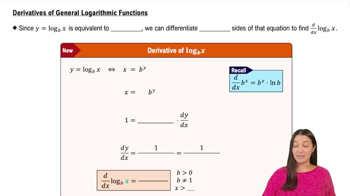
  • What is the derivative of log_b(x) with respect to x?

    The derivative is 1/(x ln(b)), where b > 0 and b ≠ 1.
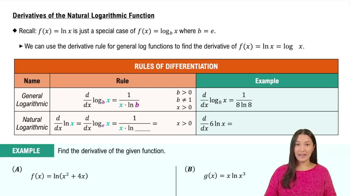
  • How do you differentiate log_8(x)?

    The derivative is 1/(x ln(8)).
  • What is the chain rule application for differentiating log_5(x^2)?

    Apply the log derivative rule to the inner function, then multiply by the derivative of x^2, resulting in 2/(x ln(5)).
  • What is the derivative of ln(x)?

    The derivative is 1/x, with the restriction that x > 0.
  • How do you differentiate f(x) = ln(x^2 + 4x)?

    The derivative is (2x + 4)/(x^2 + 4x), using the chain rule.
  • What is the derivative of g(x) = x ln(x^3) using the product rule?

    The derivative is 3 + ln(x^3), after applying the product and chain rules and simplifying.