Skip to main content
Calculus
My Course
Learn
Exam Prep
AI Tutor
Study Guides
Textbook Solutions
Flashcards
Explore
Try the app
My Course
Learn
Exam Prep
AI Tutor
Study Guides
Textbook Solutions
Flashcards
Explore
Try the app
Back
Calculus in Polar Coordinates definitions
You can tap to flip the card.
Polar Coordinates
You can tap to flip the card.
👆
Polar Coordinates
A system where points are determined by a radial distance from the origin and an angle from the positive x-axis.
Track progress
Control buttons has been changed to "navigation" mode.
1/15
Related flashcards
Related practice
Recommended videos
Calculus in Polar Coordinates quiz
Calculus in Polar Coordinates
15 Terms
Calculus in Polar Coordinates
16. Parametric Equations & Polar Coordinates
5 problems
Topic
Ernest
Conic Sections
16. Parametric Equations & Polar Coordinates
5 problems
Topic
Ernest
16. Parametric Equations & Polar Coordinates
5 topics
14 problems
Chapter
Justin
Guided course
12:18
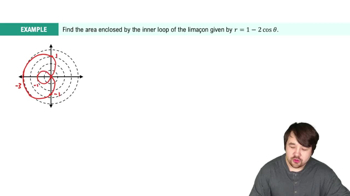
Area of Polar Regions Example 2
2
views
Guided course
09:04
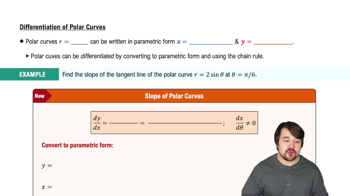
Slope of Polar Curves
2
views
Guided course
05:58
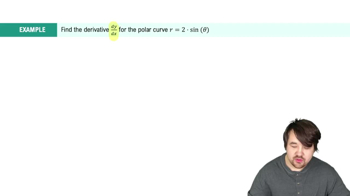
Slope of Polar Curves Example 1
2
views
Terms in this set (15)
Hide definitions
Polar Coordinates
A system where points are determined by a radial distance from the origin and an angle from the positive x-axis.
Radial Distance
The length from the origin to a point in the plane, often represented as r in equations.
Angle
A measure, usually in radians, that describes the direction of a point from the positive x-axis.
Polar Curve
A graph where each point is defined by a function of the angle, giving a unique shape in the polar plane.
Parametric Form
A representation where x and y are expressed in terms of a parameter, often using trigonometric functions of the angle.
Slope of Tangent Line
A value found by dividing the derivative of y with respect to the angle by the derivative of x with respect to the angle.
Product Rule
A differentiation technique used when finding the derivative of a product of two functions, such as f(θ) times a trigonometric function.
Chain Rule
A method for differentiating composite functions, essential when variables are nested within trigonometric functions.
Definite Integral
A calculation that sums infinitely many small quantities, used to find areas under curves or within regions.
Sector Area
The region bounded by two radii and the arc between them, calculated using one-half r squared times the angle.
Rose Curve
A polar graph with petal-like shapes, typically defined by equations involving sine or cosine of multiples of the angle.
Double Angle Identity
A trigonometric formula that rewrites expressions like 2sinθcosθ as sin2θ, simplifying calculations.
Bounds
The starting and ending values for an integral, often representing angles that define a region in polar coordinates.
Trigonometric Identity
An equation involving trigonometric functions that holds for all values of the variables, used to simplify expressions.
Chain Rule
A differentiation method for functions composed within other functions, crucial for handling derivatives in polar form.
 BackBack
 12:18
12:18