Ch. 4 - Applications of the Derivative
Briggs - Calculus: Early Transcendentals 3rd Edition
Briggs3rd EditionCalculus: Early TranscendentalsISBN: 9780136847243Not the one you use?Change textbook
Chapter 4, Problem 4.3.108

{Use of Tech} Growth rate of spotted owlets The rate of growth (in g/week) of the body mass of Indian spotted owlets is modeled by the function r(t) = 10,147.9e⁻²·²ᵗ/(37.98e⁻²·² + 1), where t is the age (in weeks) of the owlets. What value of t > 0 maximizes r? What is the physical meaning of the maximum value?

Verified step by step guidance
1
To find the value of t that maximizes the growth rate function r(t), we need to find the critical points of the function. This involves taking the derivative of r(t) with respect to t and setting it equal to zero.
The function given is r(t) = \( \frac{10,147.9e^{-2.2t}}{37.98e^{-2.2} + 1} \). We will use the quotient rule to differentiate this function. The quotient rule states that if you have a function \( \frac{u(t)}{v(t)} \), its derivative is \( \frac{u'(t)v(t) - u(t)v'(t)}{(v(t))^2} \).
Identify u(t) and v(t) from the function: \( u(t) = 10,147.9e^{-2.2t} \) and \( v(t) = 37.98e^{-2.2} + 1 \). Differentiate both: \( u'(t) = -22,325.38e^{-2.2t} \) and \( v'(t) = 0 \) since v(t) is a constant with respect to t.
Substitute u(t), u'(t), v(t), and v'(t) into the quotient rule formula to find r'(t). Simplify the expression to find the critical points by setting r'(t) = 0.
Solve the equation obtained from setting r'(t) = 0 to find the value of t that maximizes r(t). The physical meaning of the maximum value of r(t) is the age at which the growth rate of the owlets' body mass is at its highest.

Verified video answer for a similar problem:

This video solution was recommended by our tutors as helpful for the problem above.
Video duration:
6m
Was this helpful?

Key Concepts

Here are the essential concepts you must grasp in order to answer the question correctly.

Differentiation

Differentiation is a fundamental concept in calculus that involves finding the derivative of a function. The derivative represents the rate of change of a function with respect to its variable. In this context, differentiating the growth rate function r(t) will help identify the value of t that maximizes the growth rate of the spotted owlets.
Recommended video:
05:53
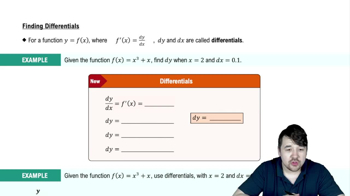
Finding Differentials

Critical Points

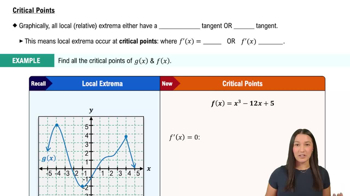
Critical points occur where the derivative of a function is zero or undefined. These points are essential for determining local maxima and minima of the function. By finding the critical points of the growth rate function r(t), we can ascertain the age of the owlets that maximizes their growth rate.
Recommended video:
04:50
Critical Points

Second Derivative Test

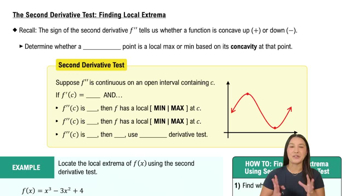
The second derivative test is a method used to determine the concavity of a function at its critical points. If the second derivative is positive at a critical point, the function has a local minimum; if negative, it has a local maximum. Applying this test to the growth rate function will confirm whether the identified critical point corresponds to a maximum growth rate for the owlets.
Recommended video:
06:02
The Second Derivative Test: Finding Local Extrema