Ch. 4 - Applications of the Derivative
Briggs - Calculus: Early Transcendentals 3rd Edition
Briggs3rd EditionCalculus: Early TranscendentalsISBN: 9780136847243Not the one you use?Change textbook
Chapter 4, Problem 61d

The figure shows six containers, each of which is filled from the top. Assume water is poured into the containers at a constant rate and each container is filled in 10 s. Assume also that the horizontal cross sections of the containers are always circles. Let h (t) be the depth of water in the container at time t, for 0 ≤ t ≤ 10 . <IMAGE>


d. For each container, where does h' (the derivative of h ) have an absolute maximum on [0 , 10]?

Verified step by step guidance
1
Understand that the problem involves finding the absolute maximum of the derivative of the depth of water, h'(t), in each container over the interval [0, 10].
Recognize that h'(t) represents the rate of change of the water depth with respect to time. Since water is poured at a constant rate, the volume of water added per unit time is constant.
Consider the shape of each container. The rate at which the water level rises, h'(t), depends on the cross-sectional area of the container at the water level. A smaller cross-sectional area results in a faster rise in water level.
For each container, identify the point where the cross-sectional area is smallest, as this is where h'(t) will be maximized. This typically occurs at the narrowest part of the container.
Evaluate the behavior of h'(t) at the endpoints of the interval [0, 10] and at any critical points found in the previous step to determine where the absolute maximum occurs.

Verified video answer for a similar problem:

This video solution was recommended by our tutors as helpful for the problem above.
Video duration:
4m
Was this helpful?

Key Concepts

Here are the essential concepts you must grasp in order to answer the question correctly.

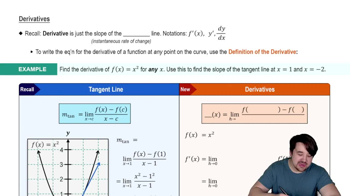
Derivatives

A derivative represents the rate of change of a function with respect to its variable. In this context, h'(t) indicates how the depth of water in the container changes over time. Understanding derivatives is crucial for analyzing the behavior of h(t) as water is poured into the containers, particularly in identifying points of maximum change.
Recommended video:
05:44
Derivatives

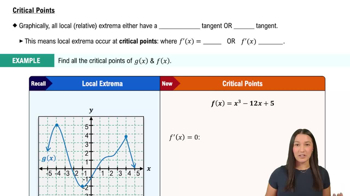
Critical Points

Critical points occur where the derivative of a function is zero or undefined. These points are essential for finding local maxima and minima. In the context of the question, identifying critical points of h'(t) will help determine where the rate of change of water depth reaches its absolute maximum within the interval [0, 10].
Recommended video:
04:50
Critical Points

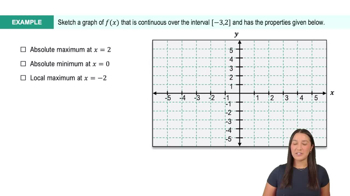
Absolute Maximum

An absolute maximum of a function on a given interval is the highest value that the function attains within that interval. To find the absolute maximum of h'(t) on [0, 10], one must evaluate the derivative at critical points and the endpoints of the interval. This concept is vital for determining the maximum rate at which the water depth changes in the containers.
Recommended video:
03:22
Finding Extrema Graphically Example 4