Ch. 3 - Derivatives
Briggs - Calculus: Early Transcendentals 3rd Edition
Briggs3rd EditionCalculus: Early TranscendentalsISBN: 9780136847243Not the one you use?Change textbook
Chapter 3, Problem 15d

Suppose the position of an object moving horizontally along a line after t seconds is given by the following functions s = f(t), where s is measured in feet, with s > 0 corresponding to positions right of the origin.
Determine the acceleration of the object when its velocity is zero.
f(t) = t2 - 4t; 0 ≤ t ≤ 5

Verified step by step guidance
1
Step 1: Find the velocity function by differentiating the position function f(t) with respect to time t. The velocity function v(t) is the first derivative of f(t), so v(t) = f'(t).
Step 2: Differentiate f(t) = t^2 - 4t to find v(t). This gives v(t) = 2t - 4.
Step 3: Set the velocity function v(t) equal to zero to find the time(s) when the velocity is zero. Solve the equation 2t - 4 = 0 for t.
Step 4: Solve the equation 2t - 4 = 0 to find the value of t when the velocity is zero. This will give you the specific time at which the velocity is zero.
Step 5: Find the acceleration function by differentiating the velocity function v(t) with respect to time t. The acceleration function a(t) is the second derivative of f(t), so a(t) = v'(t). Differentiate v(t) = 2t - 4 to find a(t).

Verified video answer for a similar problem:

This video solution was recommended by our tutors as helpful for the problem above.
Video duration:
6m
Was this helpful?

Key Concepts

Here are the essential concepts you must grasp in order to answer the question correctly.

Position, Velocity, and Acceleration

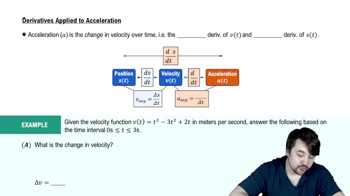
In calculus, the position of an object is described by a function s = f(t). The velocity is the first derivative of the position function, f'(t), indicating how fast the position changes over time. Acceleration is the second derivative, f''(t), representing the rate of change of velocity. Understanding these relationships is crucial for analyzing motion.
Recommended video:
06:15
Derivatives Applied To Acceleration

Finding Critical Points

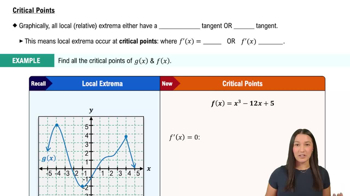
To determine when the velocity is zero, we need to find the critical points of the velocity function. This involves setting the first derivative, f'(t), equal to zero and solving for t. Critical points indicate where the object may change direction or stop, which is essential for analyzing the object's motion.
Recommended video:
04:50
Critical Points

Evaluating Derivatives

Calculating the first and second derivatives of the position function is necessary to find the velocity and acceleration. For the given function f(t) = t² - 4t, the first derivative f'(t) gives the velocity, while the second derivative f''(t) provides the acceleration. Evaluating these derivatives at the critical points allows us to determine the acceleration when the velocity is zero.
Recommended video:
5:14
Evaluate Logarithms