Determine the following limits. lim h→0 √5x + 5h − √5x / h, where x>0 Is constant
Verified step by step guidance
1
Recognize that the given expression is in the indeterminate form 0/0 as \( h \to 0 \).
To resolve the indeterminate form, multiply the numerator and the denominator by the conjugate of the numerator: \( \frac{\sqrt{5x + 5h} - \sqrt{5x}}{h} \times \frac{\sqrt{5x + 5h} + \sqrt{5x}}{\sqrt{5x + 5h} + \sqrt{5x}} \).
Simplify the numerator using the difference of squares formula: \((a - b)(a + b) = a^2 - b^2\). Here, \(a = \sqrt{5x + 5h}\) and \(b = \sqrt{5x}\), so the numerator becomes \((5x + 5h) - 5x = 5h\).
The expression now simplifies to \( \frac{5h}{h(\sqrt{5x + 5h} + \sqrt{5x})} \).
Cancel \(h\) in the numerator and denominator, then evaluate the limit as \(h \to 0\) to find the result.
Verified video answer for a similar problem:
This video solution was recommended by our tutors as helpful for the problem above
Video duration:
4m
Play a video:
0 Comments
Key Concepts
Here are the essential concepts you must grasp in order to answer the question correctly.
Limits
A limit is a fundamental concept in calculus that describes the behavior of a function as its input approaches a certain value. It helps in understanding how functions behave near specific points, which is crucial for defining derivatives and integrals. In this question, the limit as h approaches 0 is essential for evaluating the expression involving the square root.
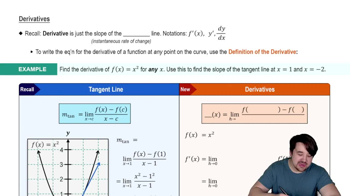
The derivative of a function represents the rate at which the function's value changes as its input changes. It is defined as the limit of the average rate of change of the function over an interval as the interval approaches zero. The expression given in the question resembles the definition of the derivative, specifically the derivative of the function √(5x) with respect to x.
Rationalization is a technique used in calculus to simplify expressions involving square roots. It often involves multiplying the numerator and denominator by the conjugate of the expression to eliminate the square root in the denominator. In the context of the limit problem, rationalizing the numerator can help in simplifying the limit expression to make it easier to evaluate.