Ch. 3 - Derivatives
Hass - Thomas' Calculus 15th Edition
Hass15th EditionThomas' CalculusISBN: 9780137616077Not the one you use?Change textbook
Chapter 3, Problem 3.8.41

A melting ice layer A spherical iron ball 8 in. in diameter is coated with a layer of ice of uniform thickness. If the ice melts at the rate of 10 in³/min, how fast is the thickness of the ice decreasing when it is 2 in. thick? How fast is the outer surface area of ice decreasing?

Verified step by step guidance
1
First, identify the variables: Let r be the radius of the iron ball, which is 4 inches (since the diameter is 8 inches). Let x be the thickness of the ice layer. The total radius of the ice-covered ball is R = r + x.
The volume V of the ice is given by the formula for the volume of a sphere: V = \( \frac{4}{3} \pi R^3 \) - \( \frac{4}{3} \pi r^3 \). Differentiate this with respect to time t to find the rate of change of volume: \( \frac{dV}{dt} = 4 \pi R^2 \frac{dR}{dt} \).
Since the ice melts at a rate of 10 in³/min, \( \frac{dV}{dt} = -10 \). Substitute this into the differentiated volume equation: \( -10 = 4 \pi R^2 \frac{dR}{dt} \).
To find \( \frac{dx}{dt} \), note that \( \frac{dR}{dt} = \frac{dx}{dt} \) because r is constant. Solve for \( \frac{dx}{dt} \) using the equation \( -10 = 4 \pi (r + x)^2 \frac{dx}{dt} \) with x = 2 inches.
For the rate of change of the surface area, use the surface area formula for a sphere: A = \( 4 \pi R^2 \). Differentiate with respect to time: \( \frac{dA}{dt} = 8 \pi R \frac{dR}{dt} \). Substitute the known values to find \( \frac{dA}{dt} \) when x = 2 inches.

Verified video answer for a similar problem:

This video solution was recommended by our tutors as helpful for the problem above.
Video duration:
4m
Was this helpful?

Key Concepts

Here are the essential concepts you must grasp in order to answer the question correctly.

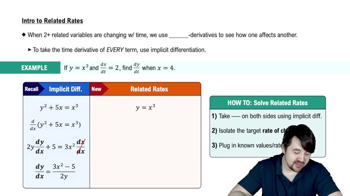
Related Rates

Related rates involve finding the rate at which one quantity changes with respect to another. In this problem, we need to determine how the thickness of the ice and the surface area change over time as the ice melts. This requires setting up equations that relate these quantities to the volume of the ice, which is decreasing at a known rate.
Recommended video:
04:16
Intro To Related Rates

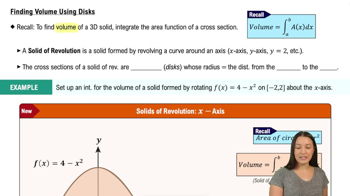
Volume of a Sphere

The volume of a sphere is given by the formula V = (4/3)πr³, where r is the radius. In this scenario, the total radius includes both the iron ball and the ice layer. Understanding how to differentiate this formula with respect to time is crucial for finding the rate at which the ice thickness changes as the volume decreases.
Recommended video:
04:48
Finding Volume Using Disks

Surface Area of a Sphere

The surface area of a sphere is calculated using the formula A = 4πr². As the ice melts, the radius of the ice layer changes, affecting the surface area. Differentiating this formula with respect to time helps determine how quickly the surface area of the ice is decreasing, which is part of the problem's requirements.
Recommended video:
09:07
Example 1: Minimizing Surface Area