Ch. 7 - Transcendental Functions
Hass - Thomas' Calculus 15th Edition
Hass15th EditionThomas' CalculusISBN: 9780137616077Not the one you use?Change textbook
Chapter 7, Problem 7.P.118

118. A particle is traveling upward and to the right along the curve y=ln(x). Its x-coordinate is increasing at the rate (dx/dt)=√x m/sec. At what rate is the y-coordinate changing at the point (e², 2)?

Verified step by step guidance
1
Identify the given information: The particle moves along the curve \(y = \ln(x)\), and the rate of change of the x-coordinate with respect to time is given by \(\frac{dx}{dt} = \sqrt{x}\) meters per second.
Recall that the rate of change of the y-coordinate with respect to time, \(\frac{dy}{dt}\), can be found using the chain rule: \(\frac{dy}{dt} = \frac{dy}{dx} \cdot \frac{dx}{dt}\).
Calculate \(\frac{dy}{dx}\) by differentiating \(y = \ln(x)\) with respect to \(x\): \(\frac{dy}{dx} = \frac{1}{x}\).
Evaluate \(\frac{dy}{dx}\) and \(\frac{dx}{dt}\) at the point \((e^{2}, 2)\): Substitute \(x = e^{2}\) into both expressions to find their values at that point.
Multiply the values found in the previous step to get \(\frac{dy}{dt}\) at the point \((e^{2}, 2)\): \(\frac{dy}{dt} = \frac{1}{e^{2}} \times \sqrt{e^{2}}\).

Verified video answer for a similar problem:

This video solution was recommended by our tutors as helpful for the problem above.
Video duration:
2m
Was this helpful?

Key Concepts

Here are the essential concepts you must grasp in order to answer the question correctly.

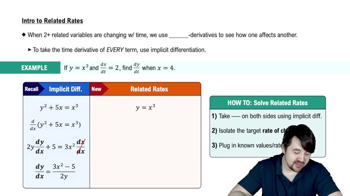
Related Rates

Related rates problems involve finding the rate at which one quantity changes by relating it to the rate of change of another quantity through their functional relationship. Here, the rates of change of x and y with respect to time are connected via the curve equation.
Recommended video:
04:16
Intro To Related Rates

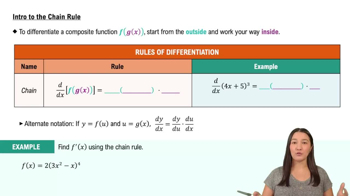
Chain Rule in Differentiation

The chain rule allows differentiation of composite functions. Since y = ln(x) depends on x, which in turn depends on time t, dy/dt is found by multiplying dy/dx by dx/dt, linking the rates of change through the chain rule.
Recommended video:
05:02
Intro to the Chain Rule

Properties of the Natural Logarithm Function

The natural logarithm function y = ln(x) has a derivative dy/dx = 1/x. This derivative is essential to find how y changes with respect to x, which is then used to determine the rate of change of y with respect to time.
Recommended video:
06:21
Properties of Functions