
Ch. 11 - Power Series
Briggs - Calculus: Early Transcendentals 3rd Edition
Briggs3rd EditionCalculus: Early TranscendentalsISBN: 9780136847243Not the one you use?Change textbook
Chapter 11, Problem 11.4.58

Representing functions by power series Identify the functions represented by the following power series.
∑ₖ₌₀∞ 2ᵏ x²ᵏ⁺¹

Verified step by step guidance
1
First, write the given power series explicitly: \(\sum_{k=0}^{\infty} 2^{k} x^{2k+1}\).
Notice that the exponent on \(x\) is \(2k+1\), which can be rewritten as \(x^{2k} \cdot x^{1} = x \cdot (x^2)^k\).
Rewrite the series as \(\sum_{k=0}^{\infty} 2^{k} x (x^2)^k = x \sum_{k=0}^{\infty} (2 x^2)^k\).
Recognize that the inner sum \(\sum_{k=0}^{\infty} (2 x^2)^k\) is a geometric series with common ratio \(r = 2 x^2\).
Recall the formula for the sum of a geometric series \(\sum_{k=0}^{\infty} r^k = \frac{1}{1-r}\), valid when \(|r| < 1\). Use this to express the series as \(x \cdot \frac{1}{1 - 2 x^2}\).

Verified video answer for a similar problem:

This video solution was recommended by our tutors as helpful for the problem above.
Video duration:
4m
Was this helpful?

Key Concepts

Here are the essential concepts you must grasp in order to answer the question correctly.

Power Series Representation of Functions

A power series is an infinite sum of terms in the form a_k(x - c)^k, where a_k are coefficients and c is the center. Functions can often be expressed as power series within a radius of convergence, allowing complex functions to be analyzed and approximated using polynomials.
Recommended video:
07:32
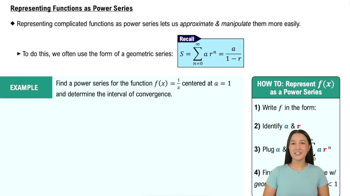
Representing Functions as Power Series

Recognizing Standard Power Series Forms

Many common functions have known power series expansions, such as geometric series, exponential, sine, and cosine. Identifying the pattern of coefficients and powers in a given series helps match it to a standard form, facilitating the identification of the represented function.
Recommended video:
05:58
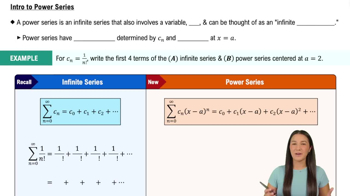
Intro to Power Series

Manipulating Series Indices and Terms

Reindexing or factoring terms in a power series can simplify it to a recognizable form. This includes adjusting powers of x, extracting constants, or rewriting sums to match known series, which is essential for identifying the function represented by a given power series.
Recommended video:
06:00
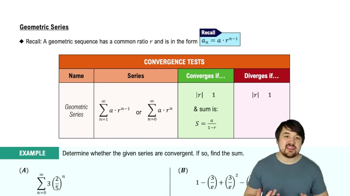
Geometric Series
Related Practice
Textbook Question

{Use of Tech} Newton's derivation of the sine and arcsine series Newton discovered the binomial series and then used it ingeniously to obtain many more results. Here is a case in point.

a. Referring to the figure, show that x = sin s or s = sin ⁻¹ x.

b. The area of a circular sector of radius r subtended by an angle θ is 1/2r²θ. Show that the area of the circular sector APE is s/2, which implies that

s = 2 ∫₀ˣ √(1 − t²) dt − x √(1 −x²)

c. Use the binomial series for f(x) = √(1 − x²) to obtain the first few terms of the Taylor series for s=sin ⁻¹ x.

d. Newton next inverted the series in part (c) to obtain the Taylor series for x=sin s. He did this by assuming sin s = ∑ aₖ sᵏ and solving x = sin(sin ⁻¹ x) for the coefficients aₖ. Find the first few terms of the Taylor series for sin s using this idea (a computer algebra system might be helpful as well).

Textbook Question

Derivative trick Here is an alternative way to evaluate higher derivatives of a function f that may save time. Suppose you can find the Taylor series for f centered at the point a without evaluating derivatives (for example, from a known series). Then f⁽ᵏ⁾(a)=k! multiplied by the coefficient of (x−a)ᵏ. Use this idea to evaluate f⁽³⁾(0) and f⁽⁴⁾(0) for the following functions. Use known series and do not evaluate derivatives.


f(x) = ∫₀ˣ sin t² dt

1
views
Textbook Question

Radius and interval of convergence Determine the radius and interval of convergence of the following power series.

∑ₖ₌₀∞ k(x−1)ᵏ

1
views
Textbook Question

Power series for derivatives


a. Differentiate the Taylor series centered at 0 for the following functions.

b. Identify the function represented by the differentiated series.

c. Give the interval of convergence of the power series for the derivative.


f(x) = eˣ

Textbook Question

Working with binomial series Use properties of power series, substitution, and factoring to find the first four nonzero terms of the Maclaurin series for the following functions. Use the Maclaurin series


(1 + x)⁻² = 1 − 2x + 3x² − 4x³ + ⋯, for −1 < x < 1.


(1 + 4x)⁻²

Textbook Question

Limits Evaluate the following limits using Taylor series.

lim ₓ→₄ (x² 16)/(ln (x 3)}

1
views