[Technology Exercise] 75. Find, to two decimal places, the x-coordinate of the centroid of the region in the first quadrant bounded by the x-axis, the curve y = arctan(x), and the line x = √3.

Ch. 8 - Techniques of Integration
Chapter 8, Problem 8.3.73
Volume: Find the volume generated by revolving one arch of the curve y = sin x about the x-axis.
Verified step by step guidance1
Identify the interval for one arch of the curve \( y = \sin x \). Since one arch corresponds to one complete wave from 0 to \( \pi \), set the limits of integration as \( x = 0 \) to \( x = \pi \).
Recall the formula for the volume \( V \) generated by revolving a curve \( y = f(x) \) about the x-axis from \( x = a \) to \( x = b \):
\[ V = \pi \int_{a}^{b} [f(x)]^{2} \, dx \]
Substitute \( f(x) = \sin x \) and the limits \( a = 0 \), \( b = \pi \) into the volume formula:
\[ V = \pi \int_{0}^{\pi} (\sin x)^{2} \, dx \]
Use the trigonometric identity to simplify \( (\sin x)^2 \):
\[ \sin^{2} x = \frac{1 - \cos(2x)}{2} \]
Rewrite the integral using this identity.
Set up the integral for evaluation:
\[ V = \pi \int_{0}^{\pi} \frac{1 - \cos(2x)}{2} \, dx \]
From here, you can integrate term-by-term to find the volume.

Verified video answer for a similar problem:
This video solution was recommended by our tutors as helpful for the problem above.
Video duration:
3mWas this helpful?
Key Concepts
Here are the essential concepts you must grasp in order to answer the question correctly.
Volume of Solids of Revolution
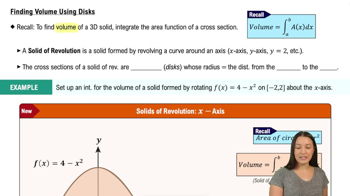
This concept involves finding the volume of a 3D solid formed by rotating a 2D curve around an axis. The volume is typically calculated using integral calculus, where the shape is sliced into thin disks or washers perpendicular to the axis of rotation.
Recommended video:
Finding Volume Using Disks
Disk Method
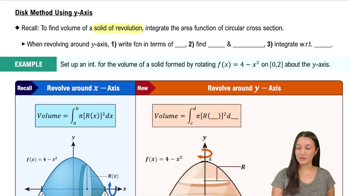
The disk method calculates volume by summing up the volumes of infinitesimally thin circular disks formed when a region is revolved around an axis. Each disk's volume is π(radius)^2 times the thickness, and integration over the interval gives the total volume.
Recommended video:
Disk Method Using y-Axis
Properties of the Sine Function
Understanding the sine function, especially one arch from 0 to π, is crucial. The function y = sin x is positive and continuous in this interval, which defines the shape of the region being revolved and sets the limits of integration for the volume calculation.
Recommended video:
Properties of Functions
Related Practice
Textbook Question
Textbook Question
Evaluate the integrals in Exercises 23–32.
∫₀^π √(1 - cos(2x)) dx
1
views
Textbook Question
In Exercises 35–68, use integration, the Direct Comparison Test, or the Limit Comparison Test to test the integrals for convergence. If more than one method applies, use whatever method you prefer.
∫ from 2 to ∞ of ((1 / ln x) dx)
Textbook Question
Use the table of integrals at the back of the text to evaluate the integrals in Exercises 1–26.
∫ dx / (x² √(4x - 9))
Textbook Question
In Exercises 27–40, use a substitution to change the integral into one you can find in the table. Then evaluate the integral.
∫ cos^(-1)(√x) / √x dx
Textbook Question
Use the formula ∫ f⁻¹(x) dx = x f⁻¹(x) - ∫ f(y) dy, y = f⁻¹(x)
To evaluate the integrals in Exercises 77-80. Express your answers in terms of x.
∫ arctan x dx