Ch. 8 - Techniques of Integration
Hass - Thomas' Calculus 15th Edition
Hass15th EditionThomas' CalculusISBN: 9780137616077Not the one you use?Change textbook
Chapter 8, Problem 8.1.34

The integrals in Exercises 1–44 are in no particular order. Evaluate each integral using any algebraic method, trigonometric identity, or substitution you think is appropriate.
∫ e^(z + eᶻ) dz

Verified step by step guidance
1
Identify the integral to solve: \(\int e^{z + e^{z}} \, dz\).
Rewrite the integrand by separating the exponent: \(e^{z + e^{z}} = e^{z} \cdot e^{e^{z}}\).
Consider a substitution to simplify the integral. Let \(u = e^{z}\), so that \(\frac{du}{dz} = e^{z} = u\), which implies \(dz = \frac{du}{u}\).
Rewrite the integral in terms of \(u\): \(\int e^{z} \cdot e^{e^{z}} \, dz = \int u \cdot e^{u} \cdot \frac{du}{u} = \int e^{u} \, du\).
Integrate \(\int e^{u} \, du\) to get \(e^{u} + C\), then substitute back \(u = e^{z}\) to express the answer in terms of \(z\).

Verified video answer for a similar problem:

This video solution was recommended by our tutors as helpful for the problem above.
Video duration:
2m
Was this helpful?

Key Concepts

Here are the essential concepts you must grasp in order to answer the question correctly.

Integration by Substitution

Integration by substitution is a method used to simplify integrals by changing variables. It involves identifying a part of the integrand as a new variable, which transforms the integral into a simpler form. This technique is especially useful when the integral contains a composite function.
Recommended video:
04:27
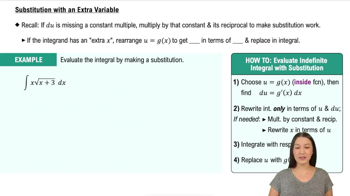
Substitution With an Extra Variable

Exponential Functions and Their Properties

Exponential functions have the form e^u, where u is a function of the variable. Understanding how to differentiate and integrate exponential functions, especially when the exponent is itself a function, is crucial. Recognizing the chain rule in reverse helps in integrating such expressions.
Recommended video:
06:21
Properties of Functions

Recognizing Composite Functions in Integrals

Composite functions are functions within functions, such as e^(z + e^z). Identifying the inner function and its derivative within the integrand allows the use of substitution. This recognition simplifies the integral by reducing it to a basic form that is easier to evaluate.
Recommended video:
3:48
Evaluate Composite Functions - Special Cases