State whether the functions represented by graphs A , B , C and in the figure are even, odd, or neither. <IMAGE>
Verified step by step guidance
1
Step 1: Understand the definitions of even and odd functions. An even function satisfies f(x) = f(-x) for all x in its domain, meaning it is symmetric with respect to the y-axis. An odd function satisfies f(-x) = -f(x) for all x in its domain, meaning it is symmetric with respect to the origin.
Step 2: Analyze the symmetry of each graph. For graph A, check if the graph is symmetric with respect to the y-axis (even) or the origin (odd).
Step 3: Repeat the symmetry analysis for graph B. Determine if graph B is symmetric with respect to the y-axis or the origin.
Step 4: Perform the same symmetry check for graph C. Look for y-axis symmetry or origin symmetry to classify the function.
Step 5: Based on the symmetry analysis, classify each function as even, odd, or neither. If a graph does not exhibit symmetry with respect to the y-axis or the origin, it is neither even nor odd.
Verified video answer for a similar problem:
This video solution was recommended by our tutors as helpful for the problem above
Video duration:
3m
Play a video:
0 Comments
Key Concepts
Here are the essential concepts you must grasp in order to answer the question correctly.
Even Functions
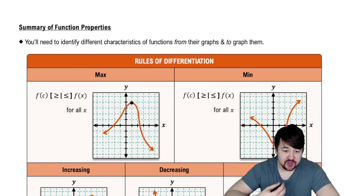
A function is considered even if its graph is symmetric with respect to the y-axis. Mathematically, this means that for every x in the domain, f(-x) = f(x). Common examples include f(x) = x² and f(x) = cos(x). Identifying even functions involves checking this symmetry visually or through algebraic verification.
A function is classified as odd if its graph is symmetric with respect to the origin. This means that for every x in the domain, f(-x) = -f(x). Examples include f(x) = x³ and f(x) = sin(x). To determine if a function is odd, one can look for this rotational symmetry or apply the algebraic condition.
A function is neither even nor odd if it does not exhibit the symmetry properties of either category. This can occur when the function has terms that do not conform to the even or odd definitions, such as f(x) = x² + x. To classify a function as neither, one must show that it fails both symmetry tests.