Ch. 8 - Techniques of Integration
Hass - Thomas' Calculus 15th Edition
Hass15th EditionThomas' CalculusISBN: 9780137616077Not the one you use?Change textbook
Chapter 8, Problem 8.3.8

Evaluate the integrals in Exercises 1–22.
∫₀^π sin⁵(x/2) dx

Verified step by step guidance
1
Recognize that the integral is \( \int_0^{\pi} \sin^5\left(\frac{x}{2}\right) \, dx \). The integrand is a sine function raised to an odd power, which suggests using a reduction formula or rewriting the power in terms of lower powers of sine and cosine.
Use the substitution \( u = \frac{x}{2} \), which implies \( du = \frac{1}{2} dx \) or equivalently \( dx = 2 du \). Also, change the limits of integration accordingly: when \( x = 0 \), \( u = 0 \), and when \( x = \pi \), \( u = \frac{\pi}{2} \).
Rewrite the integral in terms of \( u \): \[ \int_0^{\pi} \sin^5\left(\frac{x}{2}\right) dx = \int_0^{\frac{\pi}{2}} \sin^5(u) \cdot 2 \, du = 2 \int_0^{\frac{\pi}{2}} \sin^5(u) \, du. \]
Express \( \sin^5(u) \) as \( \sin^4(u) \sin(u) \) and use the identity \( \sin^2(u) = 1 - \cos^2(u) \) to rewrite \( \sin^4(u) = (\sin^2(u))^2 = (1 - \cos^2(u))^2 \). This allows the integral to be expressed as \[ 2 \int_0^{\frac{\pi}{2}} (1 - \cos^2(u))^2 \sin(u) \, du. \]
Use the substitution \( t = \cos(u) \), so \( dt = -\sin(u) du \) or \( -dt = \sin(u) du \). Change the limits for \( t \): when \( u = 0 \), \( t = \cos(0) = 1 \), and when \( u = \frac{\pi}{2} \), \( t = \cos\left(\frac{\pi}{2}\right) = 0 \). Rewrite the integral in terms of \( t \) and integrate the resulting polynomial expression.

Verified video answer for a similar problem:

This video solution was recommended by our tutors as helpful for the problem above.
Video duration:
4m
Was this helpful?

Key Concepts

Here are the essential concepts you must grasp in order to answer the question correctly.

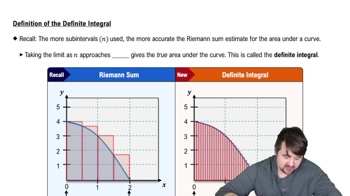
Definite Integrals

A definite integral calculates the net area under a curve between two specified limits. It is represented as ∫_a^b f(x) dx, where a and b are the limits of integration. Evaluating definite integrals often involves finding an antiderivative and then applying the Fundamental Theorem of Calculus.
Recommended video:
05:43
Definition of the Definite Integral

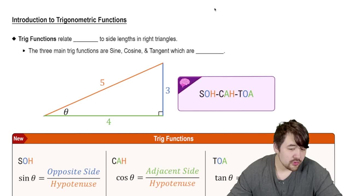
Trigonometric Integrals

Trigonometric integrals involve integrating functions containing sine, cosine, or other trig functions, often raised to powers. Techniques include using power-reduction formulas, substitution, or expressing powers in terms of multiple angles to simplify the integral before integrating.
Recommended video:
6:04
Introduction to Trigonometric Functions

Substitution Method

The substitution method simplifies integrals by changing variables to transform the integral into a more manageable form. For example, substituting u = x/2 changes the limits and the integrand accordingly, making it easier to integrate functions like sin⁵(x/2).
Recommended video:
07:33
Euler's Method