Ch. 8 - Techniques of Integration
Hass - Thomas' Calculus 15th Edition
Hass15th EditionThomas' CalculusISBN: 9780137616077Not the one you use?Change textbook
Chapter 8, Problem 8.1.54c

Using different substitutions
Show that the integral
∫((x² - 1)(x + 1))^(-2/3) dx
can be evaluated with any of the following substitutions.
c. u = arctan x
What is the value of the integral?

Verified step by step guidance
1
Start with the integral \( \int ((x^{2} - 1)(x + 1))^{-\frac{2}{3}} \, dx \). First, simplify the expression inside the integral if possible. Notice that \( (x^{2} - 1)(x + 1) = (x - 1)(x + 1)(x + 1) = (x - 1)(x + 1)^{2} \). So the integral becomes \( \int \left( (x - 1)(x + 1)^{2} \right)^{-\frac{2}{3}} \, dx \).
Apply the substitution \( u = \arctan x \). Then, differentiate both sides to find \( du \) in terms of \( dx \): \( du = \frac{1}{1 + x^{2}} \, dx \), which implies \( dx = (1 + x^{2}) \, du \).
Express the integral entirely in terms of \( u \). Since \( x = \tan u \), rewrite all parts of the integrand: \( x - 1 = \tan u - 1 \), \( x + 1 = \tan u + 1 \), and \( dx = (1 + \tan^{2} u) \, du = \sec^{2} u \, du \). Substitute these into the integral.
Rewrite the integral as \( \int \left( (\tan u - 1)(\tan u + 1)^{2} \right)^{-\frac{2}{3}} \sec^{2} u \, du \). Simplify the expression inside the parentheses if possible, and then simplify the powers and factors to get the integral in terms of \( u \) only.
Once the integral is expressed in terms of \( u \), proceed to integrate with respect to \( u \). After finding the antiderivative, substitute back \( u = \arctan x \) to express the answer in terms of \( x \).

Verified video answer for a similar problem:

This video solution was recommended by our tutors as helpful for the problem above.
Video duration:
7m
Was this helpful?

Key Concepts

Here are the essential concepts you must grasp in order to answer the question correctly.

Integration by Substitution

Integration by substitution is a method to simplify integrals by changing variables. It involves choosing a new variable u = g(x) to rewrite the integral in terms of u, making it easier to evaluate. The derivative du/dx replaces dx, and the integral limits or integrand are adjusted accordingly.
Recommended video:
04:27
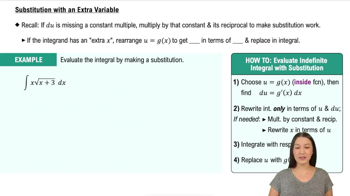
Substitution With an Extra Variable

Trigonometric Substitution

Trigonometric substitution replaces algebraic expressions with trigonometric functions to simplify integrals involving roots or powers. For example, using u = arctan(x) transforms expressions involving x into functions of u, leveraging identities like 1 + tan²u = sec²u to simplify the integrand.
Recommended video:
6:04
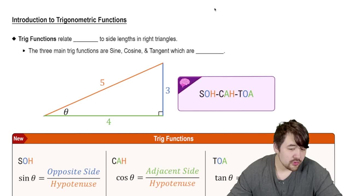
Introduction to Trigonometric Functions

Evaluating Integrals with Inverse Trigonometric Functions

When the substitution involves inverse trigonometric functions, the integral is expressed in terms of u = arctan(x). This requires rewriting x and dx in terms of u and using trigonometric identities to simplify the integrand before integrating, often resulting in expressions involving trigonometric or algebraic functions of u.
Recommended video:
06:35
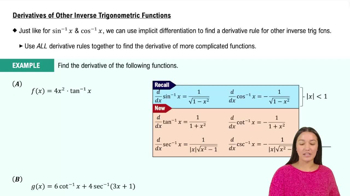
Derivatives of Other Inverse Trigonometric Functions