Ch. 7 - Transcendental Functions
Hass - Thomas' Calculus 15th Edition
Hass15th EditionThomas' CalculusISBN: 9780137616077Not the one you use?Change textbook
Chapter 7, Problem 7.3.153a

153. The linearization of 2ˣ
a. Find the linearization of f(x) = 2ˣ at x = 0. Then round its coefficients to two decimal places.

Verified step by step guidance
1
Identify the function to be linearized: \(f(x) = 2^{x}\), and the point of linearization: \(x = 0\).
Recall that the linearization of a function \(f(x)\) at \(x = a\) is given by the formula: \(L(x) = f(a) + f'(a)(x - a)\).
Calculate \(f(0)\) by substituting \(x = 0\) into the function: \(f(0) = 2^{0}\).
Find the derivative of the function: \(f'(x) = 2^{x} \ln(2)\), then evaluate it at \(x = 0\): \(f'(0) = 2^{0} \ln(2)\).
Write the linearization formula using the values found: \(L(x) = f(0) + f'(0)(x - 0)\), then round the coefficients \(f(0)\) and \(f'(0)\) to two decimal places.

Verified video answer for a similar problem:

This video solution was recommended by our tutors as helpful for the problem above.
Video duration:
2m
Was this helpful?

Key Concepts

Here are the essential concepts you must grasp in order to answer the question correctly.

Linearization of a Function

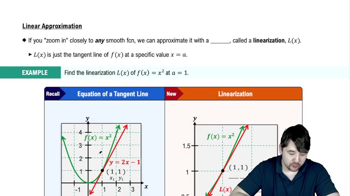
Linearization approximates a function near a point using the tangent line at that point. It is given by L(x) = f(a) + f'(a)(x - a), where a is the point of approximation. This simplifies complex functions to linear ones for easier calculations near a.
Recommended video:
07:17
Linearization

Derivative of Exponential Functions

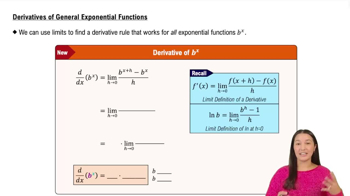
The derivative of an exponential function f(x) = a^x is f'(x) = a^x ln(a). This rule helps find the slope of the tangent line at any point, which is essential for constructing the linearization.
Recommended video:
04:50
Derivatives of General Exponential Functions

Evaluating Functions and Derivatives at a Point

To find the linearization at x = 0, you must compute both f(0) and f'(0). These values provide the y-intercept and slope of the tangent line, respectively, which are then used in the linear approximation formula.
Recommended video:
4:26
Evaluating Composed Functions