Ch. 3 - Derivatives
Briggs - Calculus: Early Transcendentals 3rd Edition
Briggs3rd EditionCalculus: Early TranscendentalsISBN: 9780136847243Not the one you use?Change textbook
Chapter 3, Problem 3.10.42

Tangent lines Find an equation of the line tangent to the graph of f at the given point.
f(x) = sin−1(x/4); (2,π/6)

Verified step by step guidance
1
First, understand that the problem is asking for the equation of the tangent line to the function f(x) = sin^(-1)(x/4) at the point (2, π/6). The tangent line will have the form y = mx + b, where m is the slope and b is the y-intercept.
To find the slope of the tangent line, we need to calculate the derivative of f(x) = sin^(-1)(x/4). The derivative of sin^(-1)(u) with respect to x is 1/√(1-u^2) * du/dx. Here, u = x/4, so du/dx = 1/4.
Substitute u = x/4 into the derivative formula: f'(x) = 1/√(1-(x/4)^2) * (1/4). This gives us the expression for the derivative of f(x).
Evaluate the derivative at the point x = 2 to find the slope of the tangent line. Substitute x = 2 into f'(x) to get the slope m.
Once you have the slope m, use the point-slope form of the equation of a line, y - y1 = m(x - x1), where (x1, y1) is the point (2, π/6). Substitute m, x1 = 2, and y1 = π/6 into this equation to find the equation of the tangent line.

Verified video answer for a similar problem:

This video solution was recommended by our tutors as helpful for the problem above.
Video duration:
5m
Was this helpful?

Key Concepts

Here are the essential concepts you must grasp in order to answer the question correctly.

Tangent Line

A tangent line to a curve at a given point is a straight line that touches the curve at that point without crossing it. The slope of the tangent line represents the instantaneous rate of change of the function at that point, which is determined by the derivative of the function.
Recommended video:
05:13
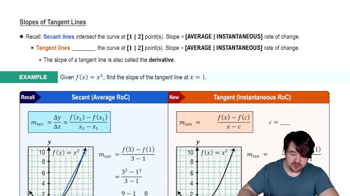
Slopes of Tangent Lines

Derivative

The derivative of a function at a point quantifies how the function's output changes as its input changes. It is calculated as the limit of the average rate of change of the function over an interval as the interval approaches zero. For the function f(x) = sin⁻¹(x/4), the derivative will help find the slope of the tangent line at the specified point.
Recommended video:
05:44
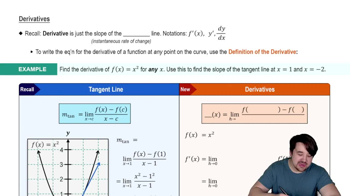
Derivatives

Inverse Trigonometric Functions

Inverse trigonometric functions, such as sin⁻¹(x), are used to find angles when given the value of a trigonometric function. In this case, sin⁻¹(x/4) gives the angle whose sine is x/4. Understanding how to differentiate these functions is crucial for finding the derivative needed to determine the slope of the tangent line.
Recommended video:
06:35
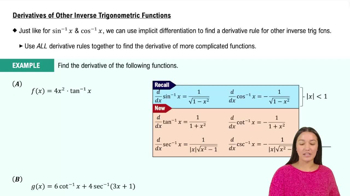
Derivatives of Other Inverse Trigonometric Functions