Ch. 3 - Derivatives
Briggs - Calculus: Early Transcendentals 3rd Edition
Briggs3rd EditionCalculus: Early TranscendentalsISBN: 9780136847243Not the one you use?Change textbook
Chapter 3, Problem 3.10.4

How are the derivatives of sin^−1 x and cos^−1 x related?

Verified step by step guidance
1
To find the derivatives of sin^−1(x) and cos^−1(x), we start by recalling their definitions. The function sin^−1(x), also known as arcsin(x), is the inverse of the sine function, and cos^−1(x), or arccos(x), is the inverse of the cosine function.
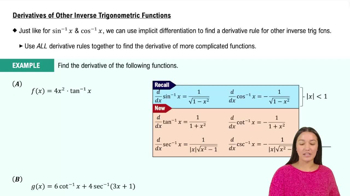
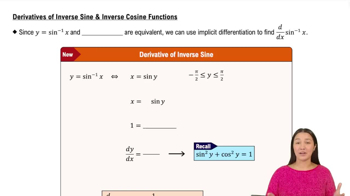
The derivative of sin^−1(x) with respect to x is given by the formula: 11-x2. This formula arises from implicit differentiation and the Pythagorean identity.
Similarly, the derivative of cos^−1(x) with respect to x is: -11-x2. Notice the negative sign in the numerator, which is due to the derivative of the cosine function being negative.
The relationship between these derivatives can be understood by observing that they are negatives of each other. This is because the sum of sin^−1(x) and cos^−1(x) is a constant, specifically π2, and the derivative of a constant is zero.
Therefore, the derivatives of sin^−1(x) and cos^−1(x) are related by the equation: 11-x2 = -11-x2, reflecting their inverse relationship.

Verified video answer for a similar problem:

This video solution was recommended by our tutors as helpful for the problem above.
Video duration:
3m
Was this helpful?

Key Concepts

Here are the essential concepts you must grasp in order to answer the question correctly.

Inverse Trigonometric Functions

Inverse trigonometric functions, such as sin^−1(x) and cos^−1(x), are the functions that reverse the action of the sine and cosine functions, respectively. They take a value from the range of the sine or cosine function and return an angle. Understanding these functions is crucial for analyzing their derivatives and their relationships.
Recommended video:
06:35
Derivatives of Other Inverse Trigonometric Functions

Derivative of Inverse Functions

The derivative of an inverse function can be found using the formula: if y = f^−1(x), then dy/dx = 1/(df/dy). This principle is essential for calculating the derivatives of sin^−1(x) and cos^−1(x), as it allows us to relate the derivatives of these inverse functions to the derivatives of their corresponding trigonometric functions.
Recommended video:
07:26
Derivatives of Inverse Sine & Inverse Cosine

Relationship Between Derivatives

The derivatives of sin^−1(x) and cos^−1(x) are related through the identity: d/dx[sin^−1(x)] + d/dx[cos^−1(x)] = 0. This indicates that the rate of change of these two functions is inversely related, reflecting the complementary nature of sine and cosine. Understanding this relationship helps in solving problems involving both functions.
Recommended video:
Guided course
5:04
Converting between Degrees & Radians