Ch. 1 - Functions
Briggs - Calculus: Early Transcendentals 3rd Edition
Briggs3rd EditionCalculus: Early TranscendentalsISBN: 9780136847243Not the one you use?Change textbook
Chapter 1, Problem 1.31

Graphing functions Sketch a graph of each function.


g(x) = { 4-2x if x ≤ 1 , (x-1)² + 2 if x > 1

Verified step by step guidance
1
Step 1: Identify the piecewise function. The function g(x) is defined in two parts: g(x) = 4 - 2x for x ≤ 1 and g(x) = (x - 1)^2 + 2 for x > 1.
Step 2: Analyze the first piece of the function, g(x) = 4 - 2x for x ≤ 1. This is a linear function with a slope of -2 and a y-intercept of 4. Sketch this line for x-values less than or equal to 1.
Step 3: Analyze the second piece of the function, g(x) = (x - 1)^2 + 2 for x > 1. This is a quadratic function, specifically a parabola that opens upwards with its vertex at (1, 2). Sketch this parabola for x-values greater than 1.
Step 4: Determine the point of transition at x = 1. For the first piece, when x = 1, g(x) = 4 - 2(1) = 2. For the second piece, as x approaches 1 from the right, g(x) = (1 - 1)^2 + 2 = 2. Both pieces meet at the point (1, 2), ensuring continuity at x = 1.
Step 5: Combine the sketches of both pieces. Draw the linear part for x ≤ 1 and the quadratic part for x > 1, ensuring they connect smoothly at the point (1, 2).

Verified video answer for a similar problem:

This video solution was recommended by our tutors as helpful for the problem above.
Video duration:
11m
Was this helpful?

Key Concepts

Here are the essential concepts you must grasp in order to answer the question correctly.

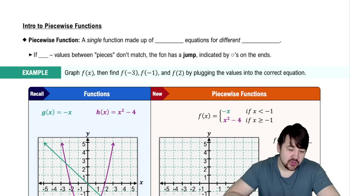
Piecewise Functions

A piecewise function is defined by different expressions based on the input value. In this case, g(x) has two distinct formulas: one for x values less than or equal to 1, and another for x values greater than 1. Understanding how to evaluate and graph each piece separately is crucial for accurately representing the entire function.
Recommended video:
05:36
Piecewise Functions

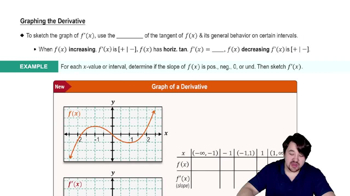
Graphing Techniques

Graphing techniques involve plotting points and understanding the behavior of functions. For piecewise functions, it is important to identify key points, such as where the function changes from one expression to another, and to ensure continuity or discontinuity at those points. This helps in creating an accurate visual representation of the function.
Recommended video:
06:15
Graphing The Derivative

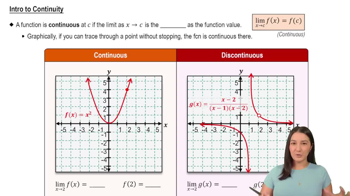
Continuity and Discontinuity

Continuity refers to a function being unbroken at a point, meaning the left-hand limit, right-hand limit, and the function value at that point are all equal. In the context of g(x), checking for continuity at x = 1 is essential, as it determines whether the graph has a jump or is smooth at that transition point.
Recommended video:
05:34
Intro to Continuity