
Ch. 7 - Logarithmic, Exponential Functions, and Hyperbolic Functions
Briggs - Calculus: Early Transcendentals 3rd Edition
Briggs3rd EditionCalculus: Early TranscendentalsISBN: 9780136847243Not the one you use?Change textbook
Chapter 7, Problem 7.1.71a

Zero net area Consider the function f(x) = (1 − x)/x
a. Are there numbers 0 < a < 1 such that ∫₁₋ₐ¹⁺ᵃ f(x) dx = 0?

Verified step by step guidance
1
First, understand the problem: we want to find if there exists a number \( a \) with \( 0 < a < 1 \) such that the definite integral \( \int_{1 - a}^{1 + a} f(x) \, dx = 0 \), where \( f(x) = \frac{1 - x}{x} \).
Rewrite the function \( f(x) \) to simplify integration: \( f(x) = \frac{1}{x} - 1 \). This allows us to split the integral into two simpler integrals.
Set up the integral as \( \int_{1 - a}^{1 + a} \left( \frac{1}{x} - 1 \right) dx = \int_{1 - a}^{1 + a} \frac{1}{x} \, dx - \int_{1 - a}^{1 + a} 1 \, dx \).
Evaluate each integral separately: \( \int \frac{1}{x} \, dx = \ln|x| \) and \( \int 1 \, dx = x \). Substitute the limits \( 1 - a \) and \( 1 + a \) into each result.
Combine the evaluated integrals to form the expression \( \left[ \ln|x| \right]_{1 - a}^{1 + a} - \left[ x \right]_{1 - a}^{1 + a} \). Set this equal to zero and solve the resulting equation for \( a \) in the interval \( (0,1) \).

Verified video answer for a similar problem:

This video solution was recommended by our tutors as helpful for the problem above.
Video duration:
3m
Was this helpful?

Key Concepts

Here are the essential concepts you must grasp in order to answer the question correctly.

Definite Integral and Net Area

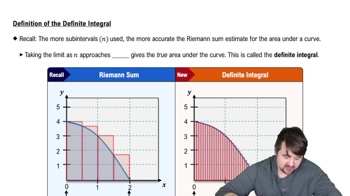
The definite integral of a function over an interval represents the net area between the function's graph and the x-axis. Positive areas above the axis add to the integral, while areas below subtract. Understanding how these areas combine is essential to determine when the integral equals zero.
Recommended video:
05:43
Definition of the Definite Integral

Behavior of Rational Functions Near Singularities

The function f(x) = (1 - x)/x has a singularity at x = 0, where it is undefined. Analyzing the function's behavior near this point and within the interval around 1 is crucial to evaluate the integral and understand how the function's sign changes affect the net area.
Recommended video:
6:04
Intro to Rational Functions

Symmetry and Interval Selection in Integration

Choosing symmetric intervals around a point (here, around x=1) can lead to cancellation of positive and negative areas in the integral. Recognizing how the function behaves on [1 - a, 1 + a] helps determine if there exists an 'a' such that the integral sums to zero.
Recommended video:
11:11
Improper Integrals: Infinite Intervals