
Textbook Question
Which series in Exercises 53–76 converge, and which diverge? Give reasons for your answers. If a series converges, find its sum.
∑ (from n = 1 to ∞) (1 − 1/n)ⁿ
1
views

 Verified step by step guidance
 8:22
8:22 8:22
8:22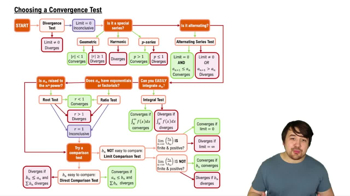 07:51
07:51Which series in Exercises 53–76 converge, and which diverge? Give reasons for your answers. If a series converges, find its sum.
∑ (from n = 1 to ∞) (1 − 1/n)ⁿ
Intervals of Convergence
In Exercises 1–36, (a) find the series’ radius and interval of convergence. For what values of x does the series converge (b) absolutely, (c) conditionally?
∑ (from n = 0 to ∞) (x + 5)ⁿ
Finding Taylor and Maclaurin Series
In Exercises 25–34, find the Taylor series generated by f at x = a.
f(x) = x³ − 2x + 4,a = 2
Finding Taylor Polynomials
In Exercises 1–10, find the Taylor polynomials of orders 0, 1, 2, and 3 generated by f at a.
f(x) = sin x,a = 0
Finding Taylor Series
Use substitution (as in Formula (7)) to find the Taylor series at x = 0 of the functions in Exercises 1–12.
e⁻ˣ/²
Use series to evaluate the limits in Exercises 29–40.
29. lim (x → 0) (e^x - (1 + x)) / x²