Ch. 1 - Functions
Hass - Thomas' Calculus 15th Edition
Hass15th EditionThomas' CalculusISBN: 9780137616077Not the one you use?Change textbook
Chapter 1, Problem 33d

State whether each function is increasing, decreasing, or neither.


d. Kinetic energy as a function of a particle’s velocity

Verified step by step guidance
1
Understand the relationship between kinetic energy and velocity. The kinetic energy (KE) of a particle is given by the formula: KE = 12mv2, where m is the mass of the particle and v is its velocity.
Identify the variable of interest. In this case, we are considering kinetic energy as a function of velocity, so v is the variable.
Differentiate the kinetic energy function with respect to velocity to determine the rate of change. The derivative of 12mv2 with respect to v is mv.
Analyze the sign of the derivative. Since mass m is positive and velocity v is also positive for increasing velocity, the derivative mv is positive.
Conclude based on the derivative. Since the derivative is positive, the kinetic energy function is increasing as a function of velocity.

Verified video answer for a similar problem:

This video solution was recommended by our tutors as helpful for the problem above.
Video duration:
2m

Key Concepts

Here are the essential concepts you must grasp in order to answer the question correctly.

Kinetic Energy Formula

Kinetic energy (KE) is defined by the formula KE = 1/2 mv², where m is the mass of the particle and v is its velocity. This formula indicates that kinetic energy is directly proportional to the square of the velocity, meaning as velocity increases, kinetic energy increases as well.
Recommended video:
Guided course
06:51
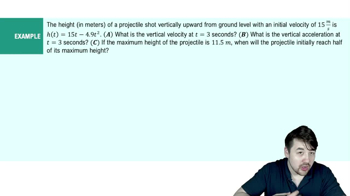
Derivatives Applied To Acceleration Example 2

Increasing and Decreasing Functions

A function is considered increasing if, for any two points x1 and x2 where x1 < x2, the function value at x1 is less than the function value at x2 (f(x1) < f(x2)). Conversely, a function is decreasing if f(x1) > f(x2) under the same conditions. Understanding these definitions is crucial for analyzing the behavior of functions.
Recommended video:
07:32
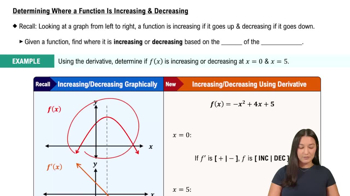
Determining Where a Function is Increasing & Decreasing

Derivative and Monotonicity

The derivative of a function provides information about its rate of change. If the derivative of a function is positive over an interval, the function is increasing; if negative, it is decreasing. For kinetic energy as a function of velocity, the derivative with respect to velocity will indicate whether the kinetic energy is increasing or decreasing as velocity changes.
Recommended video: