
Let be an antiderivative of the function . Which of the following is a correct expression for ?
Table of contents
- 0. Functions7h 55m
- Introduction to Functions18m
- Piecewise Functions10m
- Properties of Functions9m
- Common Functions1h 8m
- Transformations5m
- Combining Functions27m
- Exponent rules32m
- Exponential Functions28m
- Logarithmic Functions24m
- Properties of Logarithms36m
- Exponential & Logarithmic Equations35m
- Introduction to Trigonometric Functions38m
- Graphs of Trigonometric Functions44m
- Trigonometric Identities47m
- Inverse Trigonometric Functions48m
- 1. Limits and Continuity2h 2m
- 2. Intro to Derivatives1h 33m
- 3. Techniques of Differentiation3h 18m
- 4. Applications of Derivatives2h 38m
- 5. Graphical Applications of Derivatives6h 2m
- 6. Derivatives of Inverse, Exponential, & Logarithmic Functions2h 37m
- 7. Antiderivatives & Indefinite Integrals1h 26m
- 8. Definite Integrals4h 44m
- 9. Graphical Applications of Integrals2h 27m
- 10. Physics Applications of Integrals 3h 16m
- 11. Integrals of Inverse, Exponential, & Logarithmic Functions2h 31m
- 12. Techniques of Integration7h 41m
- 13. Intro to Differential Equations2h 55m
- 14. Sequences & Series5h 36m
- 15. Power Series2h 19m
- 16. Parametric Equations & Polar Coordinates7h 58m
7. Antiderivatives & Indefinite Integrals
Antiderivatives
Problem 4.9.3
Textbook Question
Describe the set of antiderivatives of ƒ(x) = 1
Verified step by step guidance1
Recognize that the antiderivative of a function ƒ(x) is a function F(x) such that the derivative of F(x) equals ƒ(x). In this case, we are given ƒ(x) = 1.
Recall the basic rule of integration: the antiderivative of a constant c is c * x + C, where C is the constant of integration. Here, the constant c is 1.
Apply the rule to find the antiderivative of ƒ(x) = 1. The result is F(x) = x + C, where C represents an arbitrary constant.
Understand that the set of antiderivatives of ƒ(x) = 1 is represented by the family of functions F(x) = x + C, where C can be any real number.
Conclude that the set of antiderivatives is infinite, as it depends on the value of the constant C, which can vary freely.
Verified video answer for a similar problem:This video solution was recommended by our tutors as helpful for the problem above
Video duration:
2mPlay a video:
0 Comments
Key Concepts
Here are the essential concepts you must grasp in order to answer the question correctly.
Antiderivative
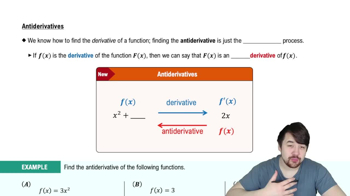
An antiderivative of a function f(x) is another function F(x) such that the derivative of F(x) equals f(x). In other words, if F'(x) = f(x), then F(x) is an antiderivative of f(x). Antiderivatives are essential in calculus as they are used to find the area under curves and solve differential equations.
Recommended video:
Antiderivatives
Constant Functions
The function f(x) = 1 is a constant function, meaning it has the same value (1) for all x in its domain. The antiderivative of a constant function is a linear function, which can be expressed as F(x) = x + C, where C is a constant. This reflects the fact that the slope of the constant function is zero, leading to a linear increase in the antiderivative.
Recommended video:
Exponential Functions
Family of Antiderivatives
The set of all antiderivatives of a function forms a family of functions that differ only by a constant. For the function f(x) = 1, the family of antiderivatives can be expressed as F(x) = x + C, where C represents any real number. This indicates that there are infinitely many antiderivatives, each corresponding to a different vertical shift of the linear function.
Recommended video:
Antiderivatives
Related Videos
Related Practice
Multiple Choice
