Ch. 3 - Derivatives
Hass - Thomas' Calculus 15th Edition
Hass15th EditionThomas' CalculusISBN: 9780137616077Not the one you use?Change textbook
Chapter 3, Problem 3.8.36

Moving along a parabola A particle moves along the parabola y = x² in the first quadrant in such a way that its x-coordinate (measured in meters) increases at a steady 10 m/sec. How fast is the angle of inclination θ of the line joining the particle to the origin changing when x = 3 m?

Verified step by step guidance
1
First, understand that the angle of inclination θ is the angle between the line joining the particle to the origin and the positive x-axis. This angle can be expressed using the tangent function: θ = arctan(y/x).
Since the particle is moving along the parabola y = x², substitute y = x² into the expression for θ: θ = arctan(x²/x) = arctan(x).
To find how fast θ is changing, differentiate θ = arctan(x) with respect to time t. Use the chain rule: dθ/dt = (dθ/dx) * (dx/dt).
Calculate dθ/dx for θ = arctan(x). The derivative of arctan(x) with respect to x is 1/(1 + x²). Therefore, dθ/dx = 1/(1 + x²).
Substitute dx/dt = 10 m/sec (given) and x = 3 m into the expression for dθ/dt: dθ/dt = (1/(1 + 3²)) * 10. Simplify this expression to find the rate at which the angle θ is changing.

Verified video answer for a similar problem:

This video solution was recommended by our tutors as helpful for the problem above.
Video duration:
6m
Was this helpful?

Key Concepts

Here are the essential concepts you must grasp in order to answer the question correctly.

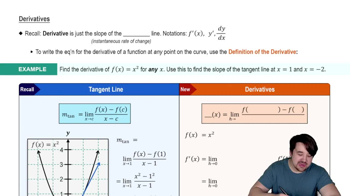
Derivative

The derivative represents the rate of change of a function with respect to a variable. In this problem, it is used to find how fast the angle of inclination θ changes as the x-coordinate of the particle increases. Calculating derivatives helps determine instantaneous rates of change, which is crucial for understanding motion along curves.
Recommended video:
05:44
Derivatives

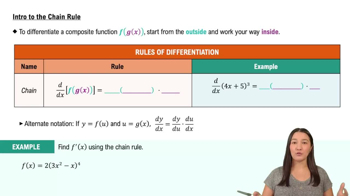
Chain Rule

The chain rule is a fundamental technique in calculus used to differentiate composite functions. It is essential here because the angle θ is a function of x, which itself changes over time. By applying the chain rule, we can relate the rate of change of θ with respect to time to the rate of change of x with respect to time.
Recommended video:
05:02
Intro to the Chain Rule

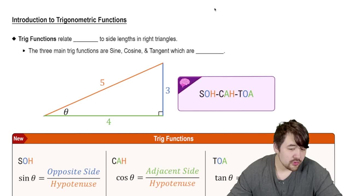
Trigonometric Functions

Trigonometric functions, such as tangent, are used to relate angles to side lengths in right triangles. In this problem, the tangent function helps express the angle θ in terms of x and y coordinates. Understanding how these functions work is crucial for translating geometric relationships into algebraic expressions that can be differentiated.
Recommended video:
6:04
Introduction to Trigonometric Functions