
Textbook Question
Theory and Examples
Maximum height of a vertically moving body The height of a body moving vertically is given by s = −12gt² + υ₀t + s₀, g > 0, with s in meters and t in seconds. Find the body’s maximum height.

 Verified step by step guidance
 06:21
06:21
 6:04
6:04 3:56
3:56Theory and Examples
Maximum height of a vertically moving body The height of a body moving vertically is given by s = −12gt² + υ₀t + s₀, g > 0, with s in meters and t in seconds. Find the body’s maximum height.
Finding Position from Velocity or Acceleration
Exercises 45–48 give the acceleration a=d²s/dt², initial velocity, and initial position of an object moving on a coordinate line. Find the object’s position at time t.
a = 9.8, v(0) = −3, s(0) = 0
Finding Indefinite Integrals
In Exercises 17–56, find the most general antiderivative or indefinite integral. You may need to try a solution and then adjust your guess. Check your answers by differentiation.
∫(cscθ cotθ) / 2 dθ
Finding Critical Points
In Exercises 41–50, determine all critical points and all domain endpoints for each function.
y = x − 3x²ᐟ³
Roots (Zeros)
Show that the functions in Exercises 19–26 have exactly one zero in the given interval.
f(x) = x³ + 4x² + 7, (−∞, 0)
Identifying Extrema
In Exercises 15–18:
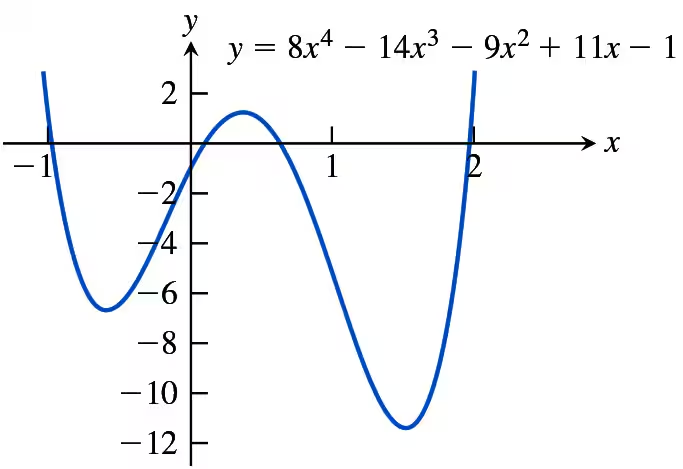
a. Find the open intervals on which the function is increasing and those on which it is decreasing.
b. Identify the function’s local and absolute extreme values, if any, saying where they occur.