Ch. 7 - Logarithmic, Exponential Functions, and Hyperbolic Functions
Briggs - Calculus: Early Transcendentals 3rd Edition
Briggs3rd EditionCalculus: Early TranscendentalsISBN: 9780136847243Not the one you use?Change textbook
Chapter 7, Problem 7.3.61a

61–62. Points of intersection and area
a. Sketch the graphs of the functions f and g and find the x-coordinate of the points at which they intersect.


f(x) = sech x, g(x) = tanh x; the region bounded by the graphs of f, g, and the y-axis

Verified step by step guidance
1
First, recall the definitions of the hyperbolic functions involved: \(f(x) = \operatorname{sech} x = \frac{1}{\cosh x}\) and \(g(x) = \tanh x = \frac{\sinh x}{\cosh x}\). Understanding their shapes will help in sketching the graphs.
Sketch the graph of \(f(x) = \operatorname{sech} x\), which is an even function with a maximum at \(x=0\) where \(f(0) = 1\), and it approaches 0 as \(x \to \pm \infty\). Then sketch \(g(x) = \tanh x\), an odd function that passes through the origin, increasing from \(-1\) to \(1\) as \(x\) goes from \(-\infty\) to \(\infty\).
To find the points of intersection, set \(f(x) = g(x)\), which means solving the equation \(\operatorname{sech} x = \tanh x\). Rewrite this as \(\frac{1}{\cosh x} = \frac{\sinh x}{\cosh x}\), and simplify to find the values of \(x\) where this holds true.
Simplify the equation to \(1 = \sinh x\). Solve for \(x\) by taking the inverse hyperbolic sine: \(x = \sinh^{-1}(1)\). This gives the x-coordinate of the intersection point(s).
To find the area bounded by the graphs of \(f\), \(g\), and the y-axis, identify the interval of integration from \(x=0\) (the y-axis) to the intersection point found. Set up the integral of the difference between the upper and lower functions over this interval: \(\text{Area} = \int_0^{x_{intersection}} (f(x) - g(x)) \, dx\). This integral will give the bounded area.

Verified video answer for a similar problem:

This video solution was recommended by our tutors as helpful for the problem above.
Video duration:
5m
Was this helpful?

Key Concepts

Here are the essential concepts you must grasp in order to answer the question correctly.

Hyperbolic Functions

Hyperbolic functions like sech(x) and tanh(x) are analogs of trigonometric functions but based on hyperbolas. sech(x) = 1/cosh(x) and tanh(x) = sinh(x)/cosh(x). Understanding their shapes and properties is essential for sketching their graphs and analyzing intersections.
Recommended video:
5:50
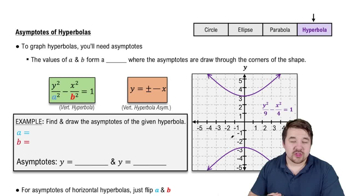
Asymptotes of Hyperbolas

Points of Intersection

Points of intersection occur where two functions have the same value for the same x-coordinate. To find these points, set f(x) equal to g(x) and solve for x. These points define the boundaries of the region enclosed by the graphs.
Recommended video:
04:50
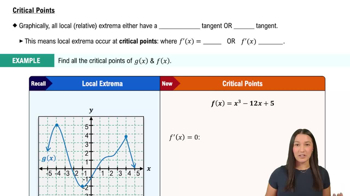
Critical Points

Area Between Curves

The area bounded by two curves and the y-axis can be found by integrating the difference of the functions over the interval defined by their intersection points and the y-axis. This involves setting up definite integrals and understanding which function lies above the other.
Recommended video:
05:23
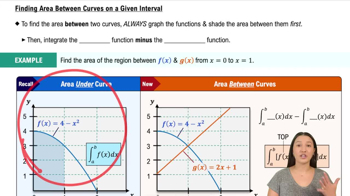
Finding Area Between Curves on a Given Interval
Related Practice
Textbook Question

Zero net area Consider the function f(x) = (1 − x)/x

a. Are there numbers 0 < a < 1 such that ∫₁₋ₐ¹⁺ᵃ f(x) dx = 0?

1
views

Textbook Question

Depreciation of equipment A large die-casting machine used to make automobile engine blocks is purchased for \$2.5 million. For tax purposes, the value of the machine can be depreciated by 6.8% of its current value each year.


a. What is the value of the machine after 10 years?

Textbook Question

ln x is unbounded Use the following argument to show that lim (x → ∞) ln x = ∞ and lim (x → 0⁺) ln x = −∞.

a. Make a sketch of the function f(x) = 1/x on the interval [1, 2]. Explain why the area of the region bounded by y = f(x) and the x-axis on [1, 2] is ln 2.

Textbook Question

Evaluating hyperbolic functions Use a calculator to evaluate each expression or state that the value does not exist. Report answers accurate to four decimal places to the right of the decimal point.

a. coth 4

Textbook Question

Projection sensitivity

According to the 2014 national population projections published by the U.S. Census Bureau, the U.S. population is projected to be 334.4 million in 2020 with an estimated growth rate of 0.79%/yr.

a. Based on these figures, find the doubling time and the projected population in 2050. Assume the growth rate remains constant.

Textbook Question

Terminal velocity Refer to Exercises 95 and 96.


a. Compute a jumper’s terminal velocity, which is defined as lim t → ∞ v(t) = lim t → ∞ √(mg/k) tanh (√(kg/m) t).