Statistics for Business
My Course
Learn
Exam Prep
AI Tutor
Study Guides
Flashcards
Explore
Try the app
My Course
Learn
Exam Prep
AI Tutor
Study Guides
Flashcards
Explore
Try the app
Back
Discrete Random Variables quiz
You can tap to flip the card.
What is a random variable in probability?
You can tap to flip the card.
👆
What is a random variable in probability?
A random variable is a variable that represents a single number determined by chance for each outcome of an experiment.
Track progress
Control buttons has been changed to "navigation" mode.
1/15
Related flashcards
Related practice
Recommended videos
Discrete Random Variables definitions
Discrete Random Variables
15 Terms
Discrete Random Variables
5. Binomial Distribution & Discrete Random Variables
10 problems
Topic

David-Paige
Binomial Distribution
5. Binomial Distribution & Discrete Random Variables
10 problems
Topic

Ernest
5. Binomial Distribution & Discrete Random Variables
3 topics
15 problems
Chapter
Ernest
Guided course
04:48
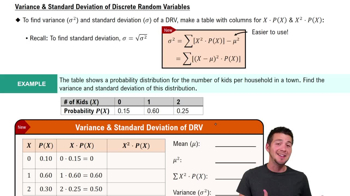
Variance & Standard Deviation of Discrete Random Variables
1
views
Guided course
03:26
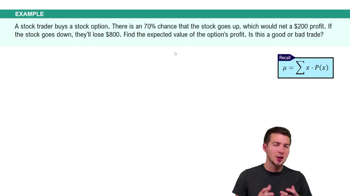
Expected Value (Mean) of Random Variables Example 2
1
views
Guided course
03:06
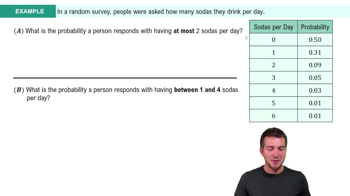
Intro to Random Variables & Probability Distributions Example 1
1
views
Terms in this set (15)
Hide definitions
What is a random variable in probability?
A random variable is a variable that represents a single number determined by chance for each outcome of an experiment.
How are discrete random variables different from continuous random variables?
Discrete random variables have distinct, countable outcomes, while continuous random variables can take any value within a range.
What is a classic example of a discrete random variable?
A dice roll is a classic example, with outcomes of 1, 2, 3, 4, 5, or 6.
What is a probability distribution?
A probability distribution is a table showing the probabilities of all possible values that a random variable can take.
What are the two criteria for a probability distribution?
All probabilities must be between 0 and 1, and the sum of all probabilities must equal 1.
How do you find a missing probability in a probability distribution table?
Subtract the sum of the known probabilities from 1 to find the missing probability.
What does 'at least' mean when calculating probabilities?
'At least' means you add up the probabilities for all outcomes that meet or exceed the specified value.
How do you calculate the mean of a discrete random variable?
Multiply each outcome by its probability, then sum these products to get the mean.
What is the equation for the mean of a discrete random variable?
The mean is calculated as μ = Σxi·P(xi), where xi is an outcome and P(xi) is its probability.
What does 'expected value' mean in probability distributions?
Expected value is another term for the mean of a probability distribution.
Why can't you just average the outcomes in a probability distribution?
Because each outcome has a different probability, so you must weight them accordingly.
How do you interpret the mean of a discrete random variable if it is not one of the possible outcomes?
It represents the average outcome over many trials, even if it is not a possible single outcome.
What does variance measure in a probability distribution?
Variance measures how spread out the outcomes of the experiment are.
How do you calculate variance for a discrete random variable?
Sum the products of each squared outcome and its probability, then subtract the square of the mean.
How is standard deviation related to variance in probability distributions?
Standard deviation is the square root of the variance.